Rainer Glaß - Professur für Neurochirurgische Forschung
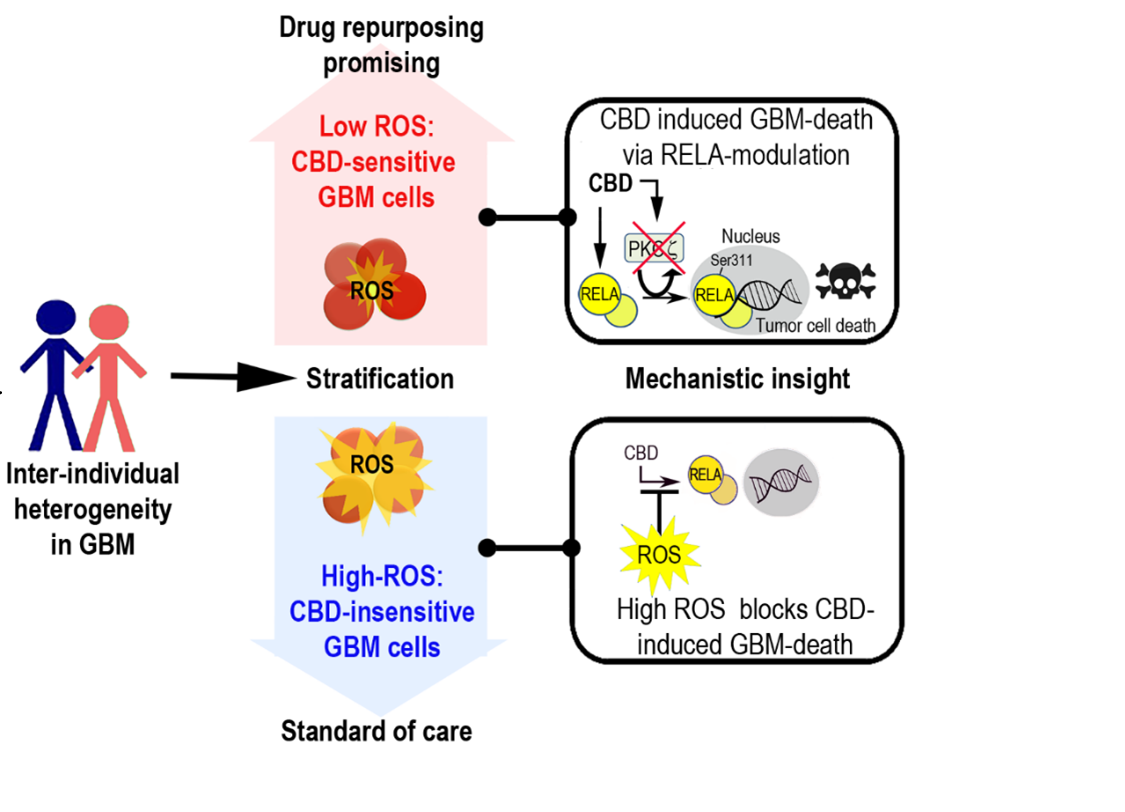
Genetisch mutierte neurale Stammzellen (NPC) können sich zu Glioblastomen entwickeln. Allerdings besitzen NPC auch (parakrine) Schutzmechanismen, die eine GBM-Bildung verhindern. Unsere Forschungsarbeiten belegten, dass NPC Cannabinoide und Vanilloide freisetzen, die GBM Zellen abtöten (https://www.doi.org/10.1038/nm.2827). Dieser anti-tumorigene Effekt lässt sich mit dem (nicht psychotropen) pflanzlichen cannabinoid Cannabidiol (CBD) nachahmen (https://www.doi.org/10.1093/neuonc/noab095). Die Biologie von GBM einzelner Patienten unterscheidet sich allerdings oft deutlich (inter-individuelle Heterogenität) und somit werden stratifizierende Marker für die therapeutische Evaluierung gebraucht. Wir konnten zeigen, dass die Bildung von Sauerstoffradikalen (reactive oxygen species; ROS) einen prädiktiven Biomarker für die CBD-Therapie darstellt. Zusätzlich haben wir den molekularen Wirkmechanismus von CBD beim GBM entschlüsselt: CBD induziert die DNA-Bindung des Transkriptionsfaktors NFkB (RELA), verhindert aber gleichzeitig eine Phosphorylierung an einem Aminosäurerest (Serin-311), der für die Transaktivierung notwendig ist. Damit konvertiert CBD das Proto-Onkogen RELA (das auch einer der zentralen Mediatoren von Entzündungsprozessen ist) in einen Tumorsuppressor (siehe schematische Abbildung). Insgesamt ermöglichen unsere Daten nun die klinische Erforschung von CBD als GBM-Therapeutikum und zeigen, warum CBD entzündungshemmende Wirkung haben könnte.
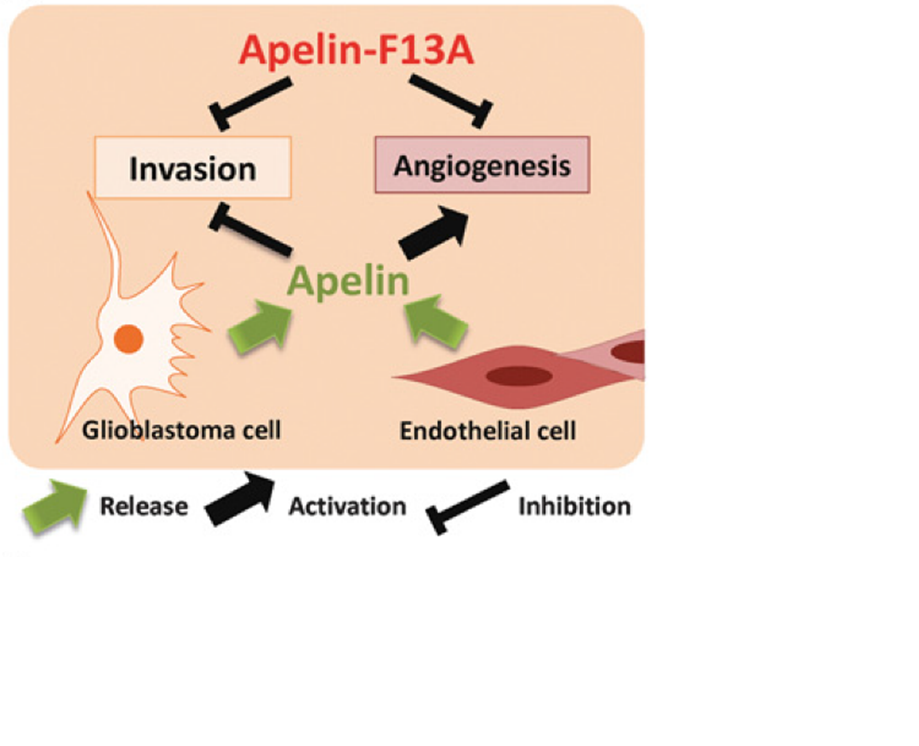
GBM sind sehr stark vaskularisierte Tumore und die Blockade der Gefäßbildung erscheint als ein Mittel, um das Tumorwachstum einzuschränken. In klinischen Studien zeigten sich allerdings auch oft adversive Effekte der Anti-Angiogenese, wie beispielsweise eine gesteigerte Tumorzellinvasion. Wir konnten (in unseren präklinischen Arbeiten) belegen, wie sich dieser unerwünschte Nebeneffekt blockieren und die anti-angiogene Therapie verbessern lässt. Das Molekül Apelin, dass im GBM in hohem Maße exprimiert wird, kontrolliert wichtige pathologische Parameter (https://www.doi.org/10.3390/cancers13153899). So zeigte sich, dass Apelin einerseits die Aussprossung von Blutgefäßen (https://www.doi.org/10.3390/ijms21114179) und anderseits die Motilität von GBM Zellen (https://www.doi.org/10.1158/0008-5472.CAN-18-0881) steuert. Ein synthetisch erstelltes und chemische verändertes Apelin-Molekül (Apelin-F13A) verändert die Signaltransduktion des Apelin-Rezeptors derart, dass beide pathologische Prozesse inhibiert werden (siehe schematische Abbildung). In dieser Studie konnten wir also einen pharmakologischen Mechanismus aufzeigen, der eine erfolgreiche Anwendung etablierter anti-angiogener Verfahren für die GBM Therapie ermöglichen kann.



Genetically mutated neural precursor cells (NPC) are a potential source for glioblastoma. However, NPC also possess (paracrine) protective mechanisms that can prevent GBM formation. In our published work, we have demonstrated that cannabinoids and vanilloids released from NPC kill GBM cells (https://www.doi.org/10.1038/nm.2827). This anti-tumorigenic effect could be reproduced by the (non-psychotropic) phyto-cannabinoid Cannabidiol (CBD) (https://www.doi.org/10.1093/neuonc/noab095). However, the biology of GBM can differ considerably from patient to patient (inter-individual heterogeneity); markers for stratification are needed to evaluate therapeutic options. We could demonstrate that the formation of reactive oxygen species (ROS) constitutes such a predicative biomarker for CBD-therapy. In addition, we unraveled the molecular mechanism for the action of CBD in GBM. CBD induces DNA binding of the transcription factor NFKB (RELA), while preventing its phosphorylation on amino acid serine-311 (which is required for transactivation). Thereby, CBD converts the proto-oncogene RELA (a central mediator of inflammation) into a tumor suppressor (see schematic). In summary, our data lay the ground for future clinical studies on CBD as a GBM therapeutic and explain the anti-inflammatory properties of CBD.
High vessel density is a hallmark of GBM and blocking tumor vascularization can interfere with tumor growth. However, clinical studies showed adverse effects of anti-angiogenesis, such as an increase in tumor cell invasiveness. In our preclinical research, we could showed how these unwanted side effects can be tackled in order to improve anti-angiogenic therapies. The molecule Apelin is strongly expressed in GBM and controls key pathological parameters (https://www.doi.org/10.3390/cancers13153899). On the one hand, Apelin induces angiogenic sprouting (https://www.doi.org/10.3390/ijms21114179) and on the other hand it reduces the motility of GBM cells (https://www.doi.org/10.1158/0008-5472.CAN-18-0881). A synthetic Apelin peptide (Apelin-F13A) modulated signal transduction through the Apelin receptor and thereby inhibited both pathological processes (see schematic figure). This study suggested that a combinatorial anti-angiogenic treatment for improved GBM therapy.