Treatment of skeletal metastases with Xofigo® (Ra-223)
Treatment with Xofigo® (Ra-223) can prolong survival in patients with bone metastases who show progression of the disease during hormone therapy. The therapy is generally approved and is covered by health insurance companies. Patients must not have organ or very large lymph node metastases.

Mode of action of therapy with Xofigo® (Ra-223)

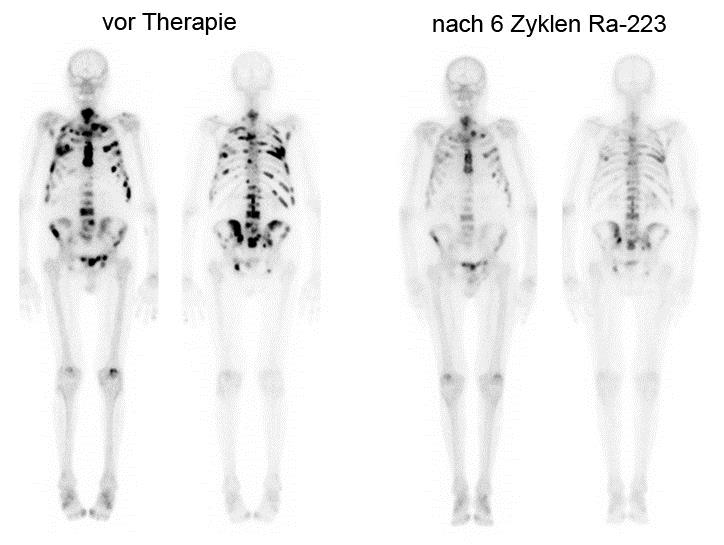
Skelettszintigraphie ventral
Skeletal scintigraphy from ventral (front) and dorsal (back) before the 1st cycle and after completion of therapy with Ra-223 dichloride. The images show a clear decrease in the metabolic activity of the bone metastases. The PSA value is of

Radium-223 is a so-called calcium analog and, like calcium, is incorporated into the hydroxyapatite of newly formed bones. This incorporation occurs to a greater extent within bone-forming (osteosclerotic or osteoblastic) metastases, which are predominantly present in prostate carcinoma. Xofigo® (Ra-223) specifically irradiates neighboring tumor cells with high-energy α-radiation and thus has a localized cytotoxic effect. Due to the low penetration depth of the α-particles, the surrounding bone marrow is spared and there are fewer side effects in the area of the hematopoietic system than with comparable bone-penetrating radiotherapeutic agents. This means that after several cycles, slower growth or even a reduction in bone involvement in prostate cancer can be achieved without affecting the patient's quality of life or the possibility of other therapies due to additional side effects.

Implementation and course of therapy

After clarification of the indication and feasibility of treatment with radium-223, the patient is informed in a detailed consultation and informed about important complications. The therapy is carried out on an outpatient basis. Six doses of Xofigo® (Ra-223) are administered at intervals of one month. Before the first and after the sixth cycle, a skeletal scintigraphy is performed to determine storage behavior and tumor infestation before the start of therapy as well as the response to the administration of radium-223.

What documents and examination results must be available before treatment with Xofigo® (Ra-223) therapy?

  • Current doctor's letter with a detailed description of the course and treatment of the prostate carcinoma to date
  • History of PSA values; the last PSA value should not be older than 4 weeks.
  • Overview of all medication taken by the patient
  • Current laboratory results (can be obtained at the Clinic and Polyclinic for Nuclear Medicine)
  • CT or MRI findings of the thorax/abdomen/pelvis (not older than 8 weeks)
  • No evidence of organ metastases or larger lymph node metastases (>3 cm).
  • Current skeletal scintigraphy (can be performed at the Clinic for Nuclear Medicine at LMU Munich)

Inclusion criteria Therapy with Ra-223

  • Castration-resistant prostate cancer with symptomatic bone metastases
  • Age over 18 years
  • Written informed consent of the patient

Exclusion criteria

  • visceral metastases
  • impaired blood count (neutropenia, thrombocytopenia or anemia depending on the extent)

If treatment with Ra-223 is not possible, e.g. due to visceral metastases, treatment with radiolabeled peptides (e.g. Lu-177 PSMA) can be carried out on an individual basis.

Registration form for Xofigo therapy Print page content

For further questions about your stay, please contact:

Dr. med. Mathias Zacherl
+49 89 4400 7 4646