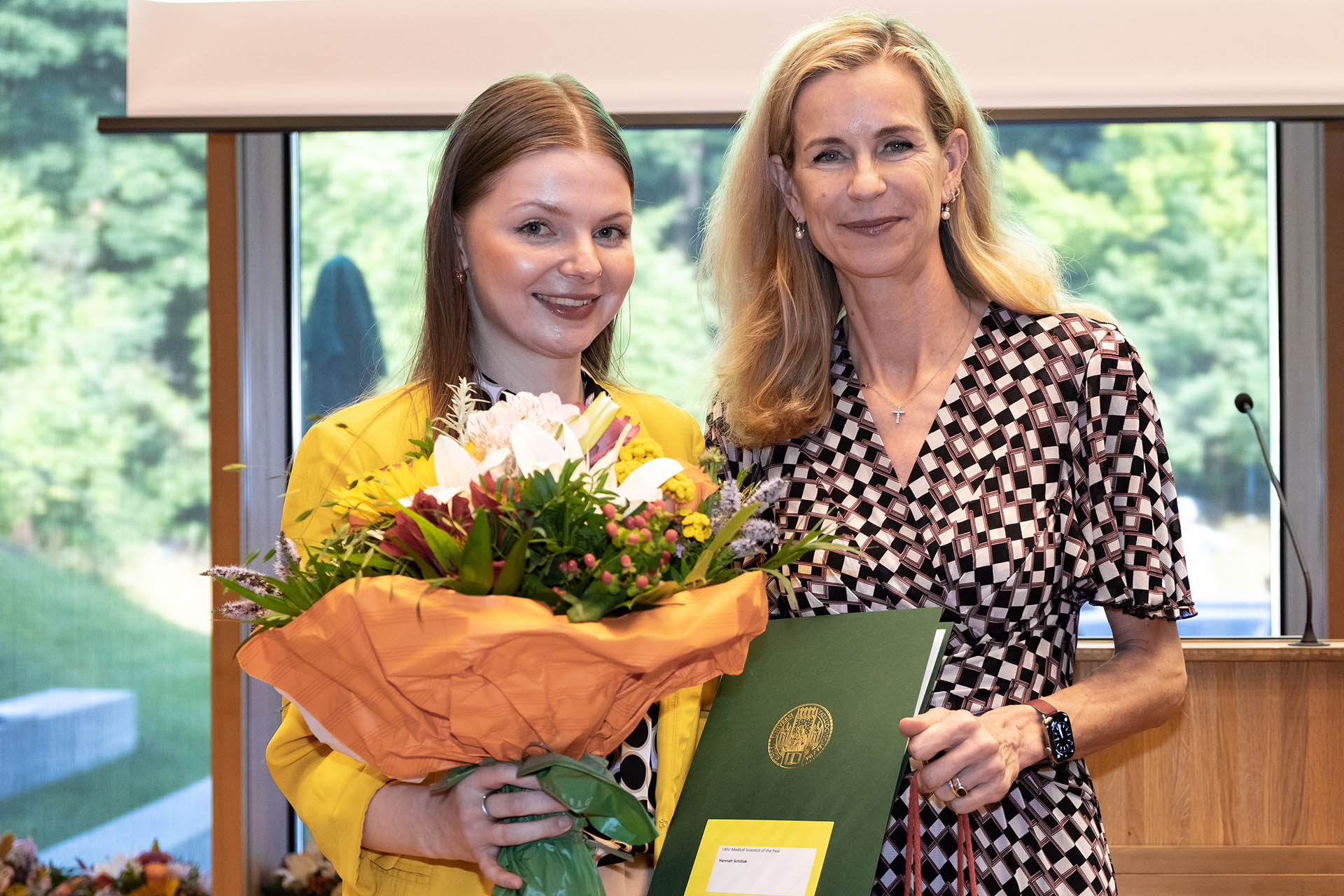
LMU Medical Scientist of the Year 2025: Hannah Schillok
About my award-winning publication
In our international meta-analysis based on individual patient data, we investigated which components of collaborative care in GP practices are particularly effective in the treatment of depression. To do this, we analyzed data from over 20,000 patients from 35 studies worldwide.Two components clearly stand out: a structured therapeutic strategy - such as manualized psychotherapy - and the active involvement of relatives, family and friends.
Our results provide concrete, evidence-based indications as to which measures are particularly helpful. They not only offer new insights for international care, but are also directly transferable to Germany - for example for the design of a planned disease management program for depression. In this way, mental health care can be further developed in a targeted, resource-conserving and practical manner.
My motivation for research
I am interested in the question of how scientific findings can be designed and processed in such a way that they can be applied in practice and in patients' everyday lives - especially for people with mental health problems, who often receive inadequate or delayed care. It motivates me to make existing gaps in care visible and to develop practical, fair solutions together with others. General practice offers an ideal framework for this: It is close to people, versatile and often the first point of contact. This is exactly where I want to start with my research - with the aim of developing evidence-based concepts that are effective, relevant to everyday life and structurally compatible.
My daily inspiration as a clinician scientist
I am particularly motivated by the close connection between research and practical care: the direct exchange with GPs, the feedback from patients in practice and the opportunity to implement evidence-based concepts where they are needed. As a clinical scientist, I work at the interface between science and application - with the aim of working with interprofessional teams to enable concrete improvements in mental health care. I am particularly motivated by the interdisciplinary collaboration, relevance and immediacy of our work.
My goals
With my work, I would like to help ensure that evidence-based care concepts are used where they have the greatest practical benefit - such as in the GP practice, which is the first point of contact for many patients and a familiar, low-threshold service. GPs can play a central role, especially for people with mental health problems who may initially feel uncomfortable or overwhelmed in inpatient settings. It is important to me to design research in such a way that it is not only methodologically sound, but also practically applicable. I am particularly keen to strengthen interprofessional collaboration and help shape care solutions that are low-threshold, fair and relevant to everyday life.
Publication:
Effective Components of Collaborative Care for Depression in Primary Care: An Individual Participant Data Meta-Analysis. Schillok H, Gensichen J, Panagioti M, Gunn J, Junker L, Lukaschek K, Jung-Sievers C, Sterner P, Kaupe L, Dreischulte T, Ali MK, Aragonès E, Bekelman DB, Herbeck Belnap B, Carney RM, Chwastiak LA, Coventry PA, Davidson KW, Ekstrand ML, Flehr A, Fletcher S, Hölzel LP, Huijbregts K, Mohan V, Patel V, Richards DA, Rollman BL, Salisbury C, Simon GE, Srinivasan K, Unützer J, Wells KB, Zimmermann T, Bühner M; POKAL Group.
JAMA Psychiatry 2025
Contact me
Mrs. Schillok, Hannah
Institute for General Medicine