Oktoberfest 2025 - the LMU Klinikum takes stock
"The Oktoberfest season went smoothly and without complications in our emergency department," says Prof. Dr. Markus Wörnle, Medical Director of the Central Emergency Department at LMU Klinikum Innenstadt, which is located just a few hundred meters from the Oktoberfest. At 1,299 cases, the number of patients during Oktoberfest 2025 was roughly comparable to the previous year. Compared to the weeks before the Oktoberfest, 17 percent more patients came to the emergency department during this year's Wiesn; this is mainly due to the increase in surgical patients. "Our surgical teams in particular worked really hard," says Wörnle. In order to provide patients with the best possible care, the surgical staff and the nursing team in the emergency department were reinforced during the Wiesn period, especially at night at the weekends.
Head injuries, arm and leg fractures and cuts
Surgical diagnoses once again lead the Wiesn injury statistics this year: "We treated 208 patients with head injuries. Injuries such as arm and leg fractures and cuts were also common," says the head of the emergency department. Minor cuts could be treated directly in the Wiesn outpatient clinic. However, as soon as vessels or nerves were affected, the injured were taken to the emergency room for treatment. "Some visitors also suffered life-threatening injuries after the Oktoberfest due to unrestrained head falls from a considerable height while under the influence of alcohol," reports Wörnle.
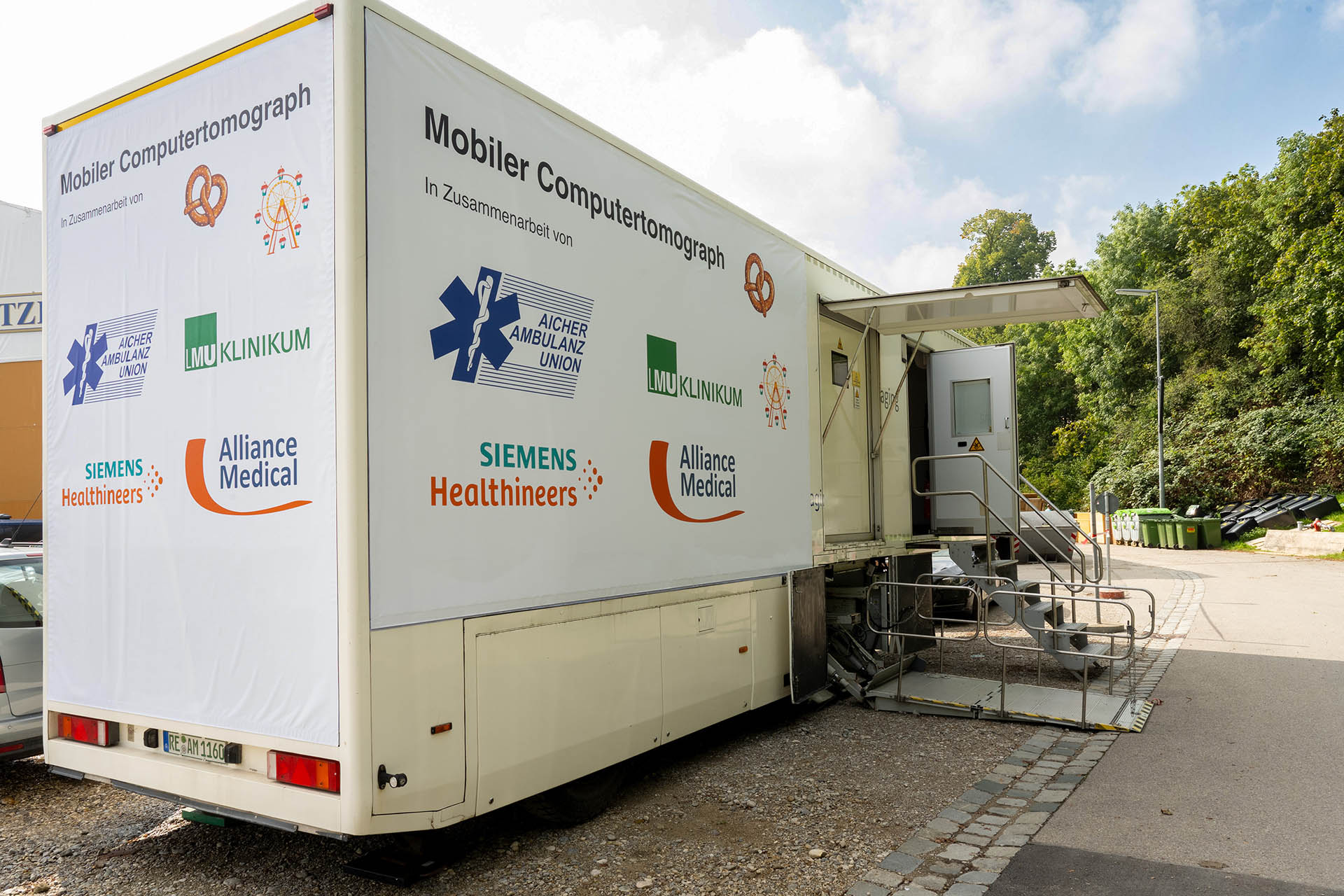
"Overall, the initial assessment and initial treatment of patients on the meadow grounds is so excellently structured that the flow of patients to us in the emergency department is very orderly," emphasizes PD Dr. Mareen Braunstein, Surgical Director of the Central Emergency Department at LMU Klinikum Innenstadt. "The use of the CT scanner at the Wiesn is also of considerable value, as many patients who have relevant injuries that can be ruled out on site do not even have to come to our emergency department." This means that, on the one hand, patients can be optimally treated on the festival grounds and, on the other, other patients at the LMU Klinikum who have nothing primarily to do with the Wiesn can be treated without delay.
Wiesn CT relieves the emergency room at LMU Klinikum Innenstadt
The LMU Klinikum has been operating the Wiesn CT in cooperation with the Aicher Outpatient Clinic since 2022. More than ten radiologists and more than 15 medical technologists for radiology worked in shifts to look after the mobile CT over the entire 16 days. "The busiest days were definitely the weekends. We had the most examinations from around 10 p.m. until the tent closed, when the mood is at its best," says Prof. Dr. Johannes Rübenthaler, Senior Physician in the Department of Radiology at the LMU Hospital. "The day with the lowest number of patients is traditionally the family day on Tuesday."
Prof. Rübenthaler and his colleagues reported around 240 CT examinations at the end of the Oktoberfest, with men, who accounted for four out of five patients, being examined significantly more frequently. "The 'classic' is falling off a beer bench while drunk," reports Rübenthaler. The case of a Wiesn visitor who had to undergo two CT scans in one day was unusual: after a fall at the Oktoberfest, he was examined in the Wiesn CT scanner and discharged home. On his way home, he fell off his bike while under the influence of alcohol - and had to undergo another CT scan in a hospital's shock room.
While the Wiesn CT is being dismantled, the emergency department team is already preparing for the next operations: "Thanks to exercises, training and our emergency concepts, the Wiesn period is easy for us to plan and the emergency department team is very well coordinated," says Wörnle. "We have more respect for the post-Wiesn period: that's when - also due to the season - more people with respiratory infections come to the emergency department and cases of illness among the staff also increase."
Three tips against the "Wiesn flu"
As the Oktoberfest draws to a close, the number of infections continues to rise. Prof. Johannes Bogner, Head of the Center for Clinical Infectiology (KLIK) at LMU University Hospital, gives three tips on how to prevent the "Wiesn flu" and the like - and how to treat it as well as possible if you do catch it.
Strengthen your immune system
A healthy and varied diet, exercise in the fresh air, sufficient sleep and plenty of fluids (besides water, tea is best for this) help the body to arm itself against viruses. Vitamin C can provide additional support, but special boosters or medication are of no benefit. If you are already ill, it is better to stay at home.
Protect others
We are seeing more cases of illness in our outpatient clinic at the end of Oktoberfest and expect that there will be even more infections in the coming days and weeks. Because they spread like a snowball, they will also affect people who were not even at the Oktoberfest. Not only the classic "Wiesn flu", but also corona plays a role this year. It is therefore worth having rapid corona tests and an FFP2 mask at home. Anyone who notices symptoms similar to illness should be tested and, if in doubt, wear a face mask - this way you not only protect yourself, but also your family, friends and colleagues.
Mitigate "Wiesn flu"
If you have caught the "Wiesn flu", how you should act depends on the severity of the symptoms. If you have a fever and cough, a rapid Covid-19 test is a good idea to protect others. Practices are likely to be full, but a visit to the doctor is advisable if high fever or other symptoms do not improve after three days. It is generally advisable to reduce fever and take it easy. If you have a cold and sinus or ear pain, decongestant nose drops can help to prevent congestion.
Read more
Stay healthy at the Oktoberfest
Wiesn tips from infectiologist Prof. Johannes Bogner
Medicine and research at the Oktoberfest
LMU Klinikum draws positive interim balance after ten days
Wiesn CT prevents rescue collapse in Munich
Radiologists at the LMU Clinic carry out the diagnosis
Read more
Staying healthy at the Oktoberfest
Wiesn tips from infectiologist Prof. Johannes Bogner
Medicine and research at the Oktoberfest
LMU Klinikum draws positive interim balance after ten days
Wiesn CT prevents rescue collapse in Munich
Radiologists at the LMU Clinic carry out the diagnosis