Antisense RNA for the treatment of severe epilepsy in premature infants
press releases | 22/04/2025
Antisense RNA for the treatment of severe epilepsy in premature infants
A child is born prematurely at the LMU Klinikum Großhadern and suffers from epileptic seizures almost continuously. The girl has an ultra-rare disease: an early and severe epilepsy with a so-called sodium channel mutation, an "SCN2A-associated developmental and epileptic encephalopathy" (SCN2A-DEE). All conventional seizure-interrupting therapies remain unsuccessful. Then a team from the Dr. von Hauner Children's Hospital, together with the Neonatology Department and the Pediatric Epilepsy Center at the LMU Clinic and the TUM Clinic, ventured a new treatment approach. The therapy initially leads to an interruption of the epileptic seizure series and ultimately to a
eventually leads to a significant reduction in the frequency of seizures. The study has now been published in the renowned journal "Nature Medicine".
TUM Klinikum
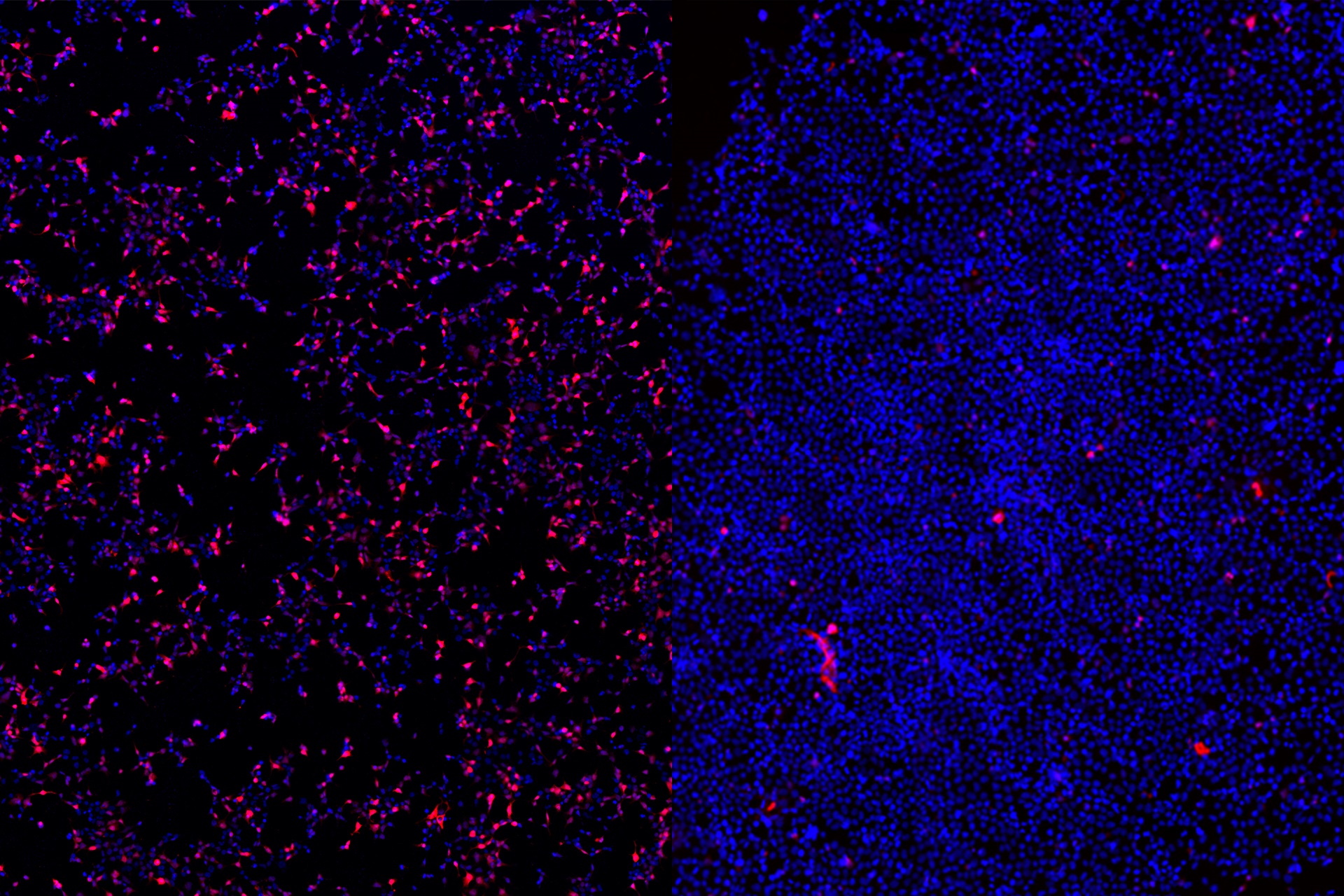
The image shows overexpression of SCN2A in HEK293T cells (marked with a red dye). After treatment of the cells with an ASO against SCN2A, there is a clear reduction in the red signal, which illustrates the effectiveness of the ASO (right image). The cell nuclei are stained in blue.
Developmental disorders and childhood epilepsies are often genetic. SCN2A-DEE is caused by mutations in the SCN2A gene. This gene leads to the production of a special protein: a sodium channel that plays a crucial role in the function of nerve cells. Changes in this gene lead to a defective protein and to impaired signal transmission in the brain. The result: very early epileptic seizures beginning before the age of three months and severe developmental disorders.
In the case of the affected child from Munich, the genetic defect was diagnosed in the womb. The value of such genetic tests has increased considerably with the advent of new precision therapies, as in the best case an innovative personalized therapy concept can be developed on the basis of a specific diagnosis. Neuropaediatrics - the specialist field that deals with neurological diseases in children and adolescents - is a pioneering discipline in this area, even if these therapies are only available for a few diagnoses to date and many scientific, technical, ethical and care-specific questions remain unanswered.
Small RNA fragments offer hope
Antisense oligonucleotides (ASOs) play a special role in the context of precision therapies. These are small nucleic acid fragments that bind RNA, can intervene to modulate cell biology and are seen as a particular source of hope in precision medicine. For example, they can inhibit the production of disease-promoting proteins. The ASO 'Elsunersen' used in the new study targets the mRNA of the SCN2A gene and leads to its degradation. This means that no faulty protein can be produced, which causes the symptoms of the disease.
The doctors injected the Elsunersen directly into the girl's spinal canal. Conventional therapy was carried out in parallel. The result: an interruption of the permanently existing seizures and a reduction in the frequency of seizures by more than 60 percent to five to seven seizures per hour, which lasted until the age of 22 months and enabled clinical care stability. Nevertheless, the severe neurological developmental disorders remained, possibly due to the long period of time with the disease in the womb. Regarding the safety of the treatment, there were no serious side effects over a period of 20 months of therapy with 19 administrations.
Precision therapies will become increasingly important in medicine
"The study underlines the potential of ASO therapies for genetic diseases," says Dr. Matias Wagner, group leader for nucleic acid therapies at the Institute of Human Genetics at the TUM Clinic and also working at the LMU Clinic during the study phase: "On the one hand, there will be the use of approved drugs for precision therapies in the future or we will test their effectiveness in clinical studies at the center. On the other hand, there are patients for whom no such treatment option is yet available. We would like to develop effective ASO therapies for these patients."
"With the advent of ASO therapies, a new chapter in epileptology has begun," emphasizes Prof. Ingo Borggräfe, Head of the Pediatric Epilepsy Center at LMU Hospital: "Successful treatment requires extensive clinical experience, considerable human and logistical resources and interdisciplinary cooperation, which will continue to shape the orientation of our center now and in the coming years."
The Munich team and its cooperation partners now want to develop ASOs for other rare neuropaediatric diseases, embedded in competent care structures and building on the knowledge gained and the expertise of the participating research groups within this cross-university network.
Publication
First author: Matias Wagner (TUM), last author Ingo Borggräfe (LMU)
Wagner, M., Berecki, G., Fazeli, W. et al. Antisense oligonucleotide treatment in a preterm infant with early-onset SCN2A developmental and epileptic encephalopathy. Nat Med (2025). DOI: https://doi.org/10.1038/s41591-025-03656-0
Participating institutions:
LMU Clinic
TUM Clinic
University Hospital Bonn (UKB)
The Florey Institute, Australia
Medicover Diagnostics Martinsried
Practice Precision Medicines Inc.
Funding:
The study was made possible by an Expanded Access Program from Praxis Precision Medicines. The study was further supported by a Fellowship in the Hertie Network of Excellence in Clinical Neuroscience of the non-profit Hertie Foundation.
Nursing with heart and expertise: Experience the Nursing Careers Day at LMU Hospital on June 27, 2025 - a day full of inspiring insights into the demanding and holistic everyday life of nursing. Meet experts, discover a wide range of career opportunities and receive exciting information on jobs, training and further education. Come along, exchange ideas with colleagues and let yourself be inspired by nursing science in practice - without obligation and without registration.