News | 12/11/2025

10 years of the Clinical Ethics Committee at the LMU Hospital

The Clinical Ethics Committee, or CEC for short, has been supporting the LMU Hospital with ethical issues relating to patient care for ten years. The CEC dedicated its anniversary event, which took place on October 28 at Großhadern Hospital, to a particularly sensitive topic: patients' wishes for assisted suicide. Since the ruling of the Federal Constitutional Court, which allows assisted suicide, neither the legislator nor the medical profession have created regulations for this. A panel of experts consisting of doctors, lawyers, forensic doctors and medical ethicists discussed the complex ethical, legal and practical issues surrounding assisted suicide with participants including Catholic clergy and doctors with experience in assisted suicide.
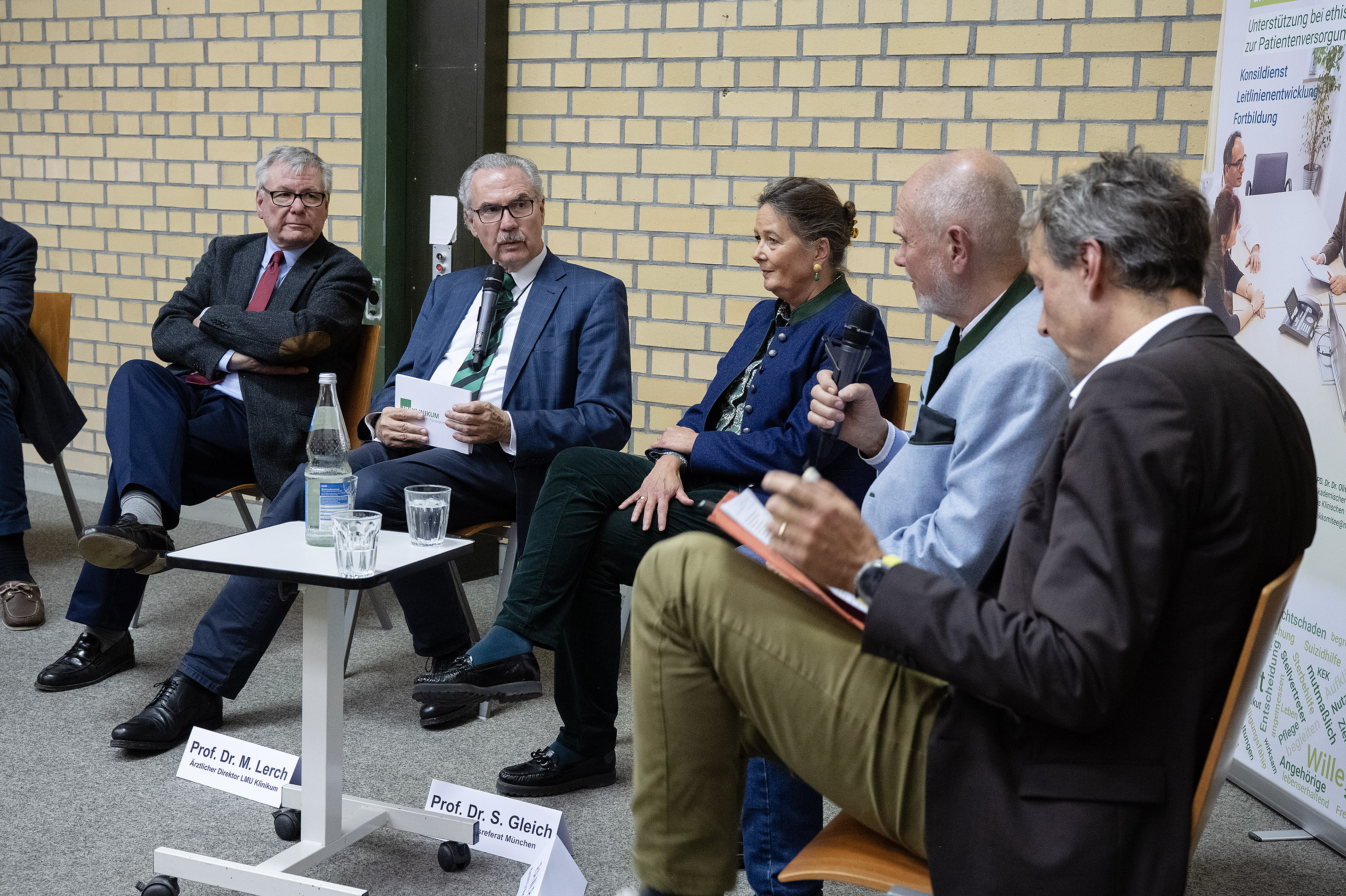
From left to right: Prof. Thomas Pollmächer (Ingolstadt Hospital), Prof. Dr. Markus Lerch (LMU Hospital), Prof. Sabine Gleich (Institute of Forensic Medicine), Wolfgang Putz (lawyer and expert in medical law) and Prof. Georg Marckmann (LMU Munich) discussed the topic of assisted suicide

In his opening statement , Prof. Markus Lerch, Medical Director of the LMU Klinikum, cited the ruling of the Federal Constitutional Court from 2020, in which the 'right to a self-determined death expressly includes the freedom to take one's own life and to seek the help of others in doing so'. This declared the personal autonomy and free responsibility of the individual to be a high legal right. In 2015, Canada's highest court placed patient autonomy above other legal rights and assisted suicide, known in Canada as 'Medical Assistance in Dying' (MAID), was originally permitted for exceptional cases at the end of life in the case of illnesses leading to death. In 2023, however, MAID was the fifth most common cause of death in Canada with 15,343 assisted suicides (4.7% of all deaths) and 1,837 experts (doctors and nurses) had specialized in the practice of MAID. In contrast to Germany with an estimated 1000 cases per year, in Canada it is almost always a case of killing on demand. The application now includes people aged 18 and over, dementia patients and people without terminal illness. In Germany, since the Constitutional Court ruling, there is neither a legal regulation, nor a register for recording cases, nor binding guidelines for the practice of assisted suicide from the medical profession.

Renowned experts

Wolfgang Putz, lawyer and expert in medical law and patients' rights at the end of life from Munich, who made a significant contribution to the Constitutional Court's ruling with his constitutional complaint, appealed to the medical profession to establish standards for determining the free responsibility of a suicide wish in order to ensure greater legal certainty. This could not be done competently by either the legislator or the courts. Prof. Thomas Pollmächer (Ingolstadt Hospital) addressed the challenges of such assessments from a psychiatric perspective. For example, free will cannot be proven by the comprehensibility of a suicide wish, nor can it be ruled out on the basis of a psychiatric illness. Prof. Georg Marckmann (Institute for Ethics, History and Theory of Medicine, LMU Munich) broadened the perspective from a protection concept to a support concept for people with a wish to die. Not only should the capacity for self-determination be examined, but individual paths should be developed together with the patients in the sense of "shared decision making".

Prof. Sabine Gleich reported on a study by the City of Munich's Health Department and the Institute of Forensic Medicine at LMU on the number of assisted suicides carried out in Munich in 2020-2023. The numbers had risen annually to a total of 77 cases, accompanied by a small number of medical suicide assistants working for euthanasia organizations. There were striking indications of a lack of protection concepts for particularly vulnerable groups (e.g. people with previous suicide attempts) as well as complications with a drug used. Prof. Michael von Bergwelt (Medical Clinic III, LMU Klinikum) referred to the successes in his field, oncology. These enable patients to live longer and better with cancer. Against this background, he warned of the possible effects of the increasing presence of assisted suicide in social media. This could lead to dubious and frivolous requests for suicide.

Unresolved questions

There was a consensus among those present that there is no objective need to carry out assisted suicide in a hospital. In countries where assisted suicide is permitted and regulated, such as the Netherlands, this wish was fulfilled in most cases in the home environment of the person seeking help. The lesson to be learned from Canada is that a development that advocates the autonomy of the individual as the highest good can lead to conflicts with social and Christian values, for which suicide prevention is paramount. The role of euthanasia organizations, the specialization of doctors in this field, the services offered by morticians for assisted suicide and the necessary qualifications of suicide helpers were also controversially discussed. Prof. Marckmann reported on the work on a guideline on the topic with the participation of numerous medical societies. As moderator, Prof. Lerch expressed his thanks for the objective, respectful and appreciative discussion between the representatives of very different positions. Experts and participants agreed on the need to discuss the topic openly within the medical profession in order to develop a responsible approach to assisted suicide and prevent possible undesirable developments. "The anniversary event at the LMU Klinikum provided important impetus for this," said the Chair of the Clinical Ethics Committee at the LMU Klinikum, Prof. Claudia Bausewein (Department of Palliative Medicine).


You can find out more about the work of the Clinical Ethics Committee at the LMU Klinikum in the current issue of the patient magazine Klinikum aktuell on pages 16 and 17.

Contact us

Office of the Clinical Ethics Committee

LMU Hospital Munich

Originally translated with DeepL