Telemedical care for Parkinson's patients
Around 400,000 people in Germany are currently living with Parkinson's disease - a progressive disease which, in addition to the cardinal motor symptoms of lack of movement, muscle stiffness, tremors at rest and postural disorders, causes a variety of other non-motor symptoms that can significantly impair quality of life.
Thanks to innovative treatment approaches, it is now possible to effectively alleviate the symptoms. However, not all regions in Bavaria have the opportunity to provide their own specialized department or clinic for individual and high-quality medical care for Parkinson's patients. The PARKLINK cooperation network was founded to close this gap and offer those affected optimal care close to home, which is also linked to the expertise of a university hospital: a collaboration of 11 clinics from Upper and Lower Bavaria, the Upper Palatinate and Upper Swabia, which was initiated by the Neurological Clinic at LMU Klinikum.
New therapies such as deep brain stimulation
"PARKLINK combines modern, guideline-based Parkinson's therapy with the latest research findings. Uniform standards enable access to innovative diagnostic and treatment procedures," explains Prof. Günter Höglinger, Director of the Neurological Clinic and Polyclinic at LMU University Hospital. This includes state-of-the-art imaging and laboratory diagnostic examinations as well as advanced treatment options such as therapy with drug pumps.
therapy options such as therapy with drug pumps for a constant supply of medication or deep brain stimulation: "Deep brain stimulation can be an effective alternative for Parkinson's patients for whom medication is no longer sufficient. This is because the procedure uses electrical impulses in the brain to very effectively alleviate motor symptoms. Thanks to modern technologies and well-tolerated anaesthetic procedures, the treatment is particularly gentle today," explains Dr. Thomas Köglsperger, coordinator of PARKLINK and Head of the Outpatient Clinic for Deep Brain Stimulation, Pump Therapy and Parkinson's Complex Treatment at the Neurological Clinic of the LMU Hospital.
Digital medicine: telemedicine & wearables
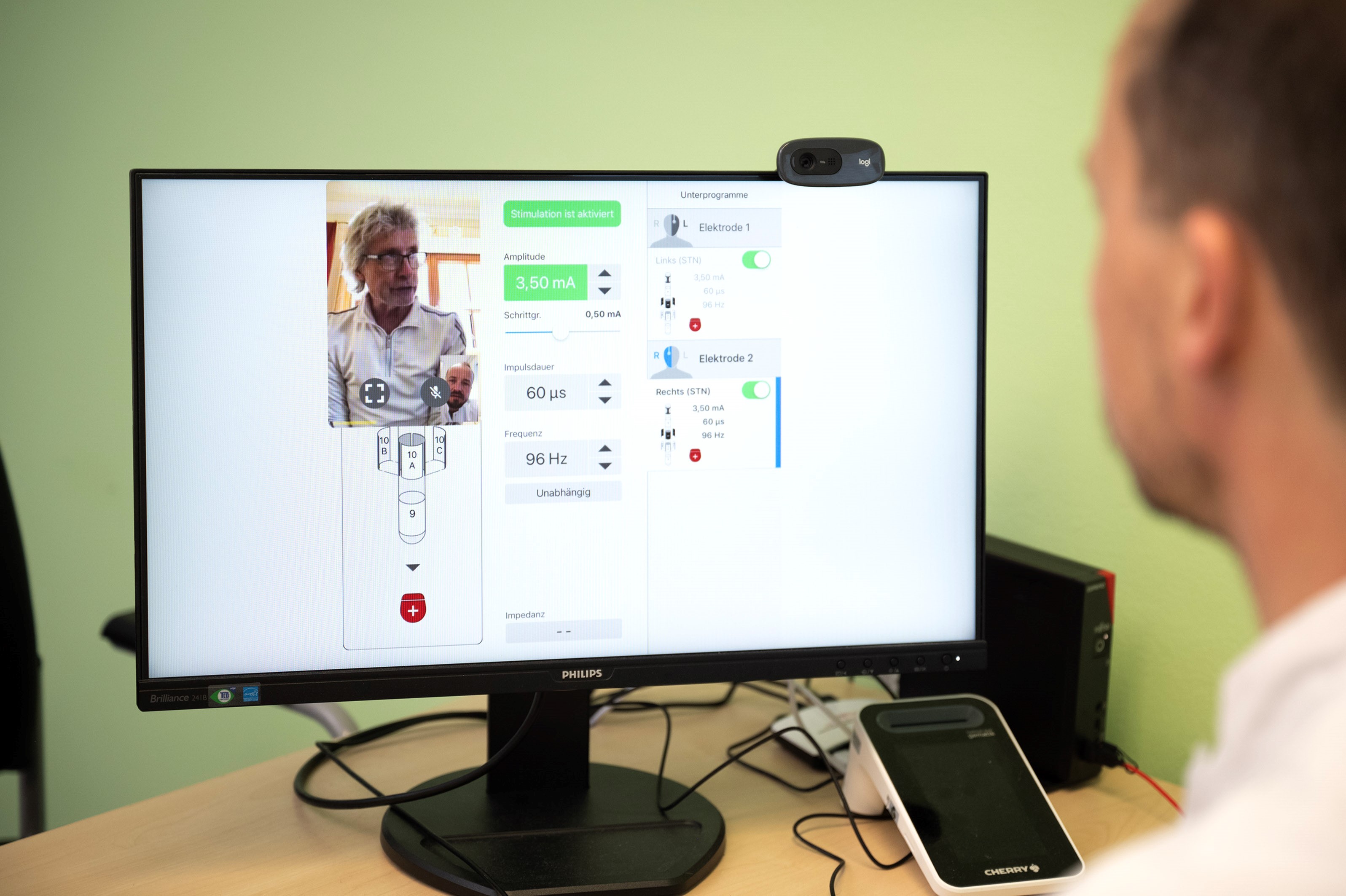
Whether deep brain stimulation - or another treatment option - is promising in individual cases is discussed and decided with the help of telemedicine in interdisciplinary case conferences with the specialists at the respective partner clinic. "We can also use the video connection to precisely adjust a brain stimulator remotely," says PD Dr. Köglsperger.
New digital technologies also enable precise therapy adjustment and location-independent care for Parkinson's patients. For example, special portable movement sensors - known as wearables - enable the continuous recording and monitoring of typical Parkinson's symptoms in order to be able to react promptly to a deterioration or severe fluctuations with an adapted therapy.
Parkinson's patients who are cared for by PARKLINK also have the opportunity to take part in studies at the LMU Clinic. And as the disease also entails many changes for relatives, they are also actively involved through training.
PARKLINK also offers further training for specialist staff and regular patient information days. Structured training courses and uniform quality standards ensure that the latest findings are incorporated directly into practice.
Reference to two patient events:
Parkinson's - a field in motion
Friday, April 11, 2025, 2:30 to 5:00 p.m. at the LMU Klinikum Großhadern, Lecture Hall 5
Atypical Parkinson's syndromes - a field on the move
Saturday, April 12, 2025, 9.30 to 11.30 a.m. at LMU Klinikum Großhadern, Lecture Hall 5
The PARKLINK network:
- LMU Clinic Munich, Neurological Clinic and Polyclinic
- Clinic for Neurology and Epileptology at the Center for Psychiatry Südwürttemberg Ravensburg, Epileptology Ravensburg-Bodensee
- Kaufbeuren Clinic, Neurological Clinic
- Mainkofen District Hospital, Neurological Center, Deggendorf
- Helios Clinic Munich West, Neurological Clinic
- Artemed Clinic Tutzing, Neurological Clinic
- Center for Movement Disorders Passauer Wolf Bad Gögging,
- Acute inpatient Parkinson's specialist clinic and neurological rehabilitation center
- Agatharied Clinic, Neurological Clinic, Hausham
- Medical Park Clinic Loipl, Bischofswiesen
- Medical Park Bad Feilnbach, Reithofpark
- Kreisklinik Ebersberg, Department of Acute Geriatrics
- Passau Clinic, Neurological Clinic
- More information at www.parklink.info
The work of PARKLINK is supported by the LMU Foundation Fund: www.nerven-behalten.org
Contact
Prof. Dr. med. Günter Höglinger
Director of the Neurological Clinic and Polyclinic, LMU Klinikum München, Großhadern Campus
PD Dr. med. Thomas Köglsperger
Senior consultant at the Neurology Clinic and Polyclinic, LMU Klinikum München, Großhadern Campus