News | 30/09/2026

New publication in Cell: Gut metabolites shape CAR-T cell therapy

Congratulations to the authors! We warmly congratulate all authors on this important publication, with special congratulations to the members of our Institute: Philipp Menauer, Simon Delahais, Marcel Trefny, Janina Dörr and Sebastian Kobold.
The findings provide new insights into the mechanisms linking the gut microbiome to CAR-T cell therapy and may contribute to the development of metabolite-guided and microbiome-based therapeutic strategies to improve treatment outcomes.
We are pleased to announce the publication of a new study in Cell resulting from a collaboration between the AG Kobold at the Institute for Clinical Pharmacology, LMU Klinikum, and the AG Poeck at University Hospital Regensburg.

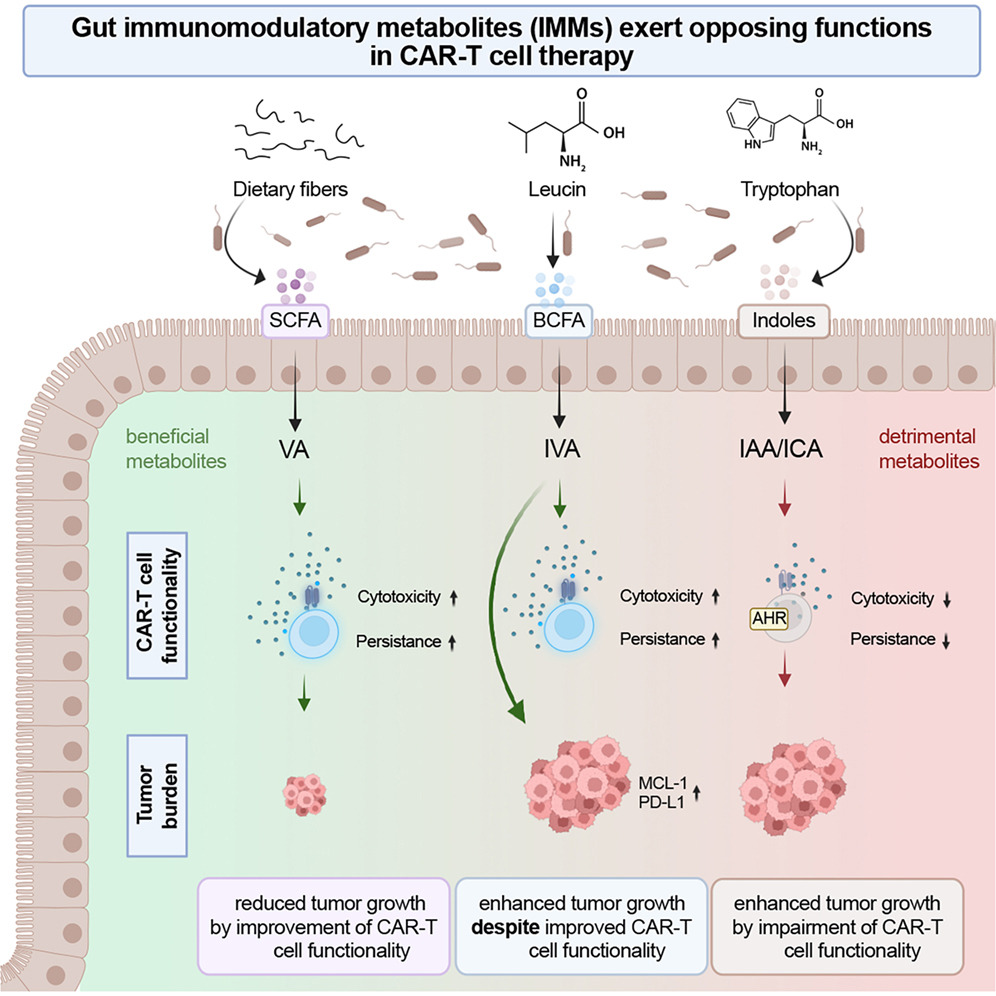
The study, entitled “Opposing functions of gut immunomodulatory metabolites on CAR-T therapy,” investigates how metabolites produced by the gut microbiome influence the efficacy of chimeric antigen receptor (CAR)-T cell therapy.

In this study, the researchers analyzed 129 patients across three German centers, combining shotgun metagenomics with targeted mass spectrometry to investigate the relationship between gut-derived metabolites and clinical outcomes following CAR-T cell therapy.

The results revealed that reduced levels of short-chain fatty acids, particularly valeric acid, prior to CAR-T cell therapy were associated with an increased risk of disease progression. In contrast, elevated levels of several indole metabolites, including indole-3-carboxaldehyde and indole-3-acetic acid, as well as the branched-chain fatty acid isovaleric acid, were associated with adverse clinical outcomes.

The findings therefore highlight the complex and metabolite-specific role of the gut microbiome in CAR-T cell therapy.

Paper here