News | 07/10/2021

The Tropical Institute hands over exhibits from the early days of the pandemic to the Haus der Bayerischen Geschichte

On Tuesday morning, the Haus der Bayerischen Geschichte's coronavirus collection received another addition. The medical team led by Prof. Dr. med. Michael Hoelscher, Director of the Tropical Institute at LMU Klinikum München, presented Dr. Timo Nüßlein, the research assistant at the Haus der Bayerischen Geschichte responsible for the museum collection, has donated objects from the early days of the coronavirus pandemic: a barrier tape that was used in the Tropical Institute on day 2 of the pandemic in Germany to prevent infection: an information banner to indicate the COVID-19 test station of the Munich Tropical Institute, a poster with rules of conduct for visitors to the station and also one of the first "passes" to be able to move freely around Munich for service as a healthcare worker during the first lockdown in Bavaria, dated 20.3.2020.
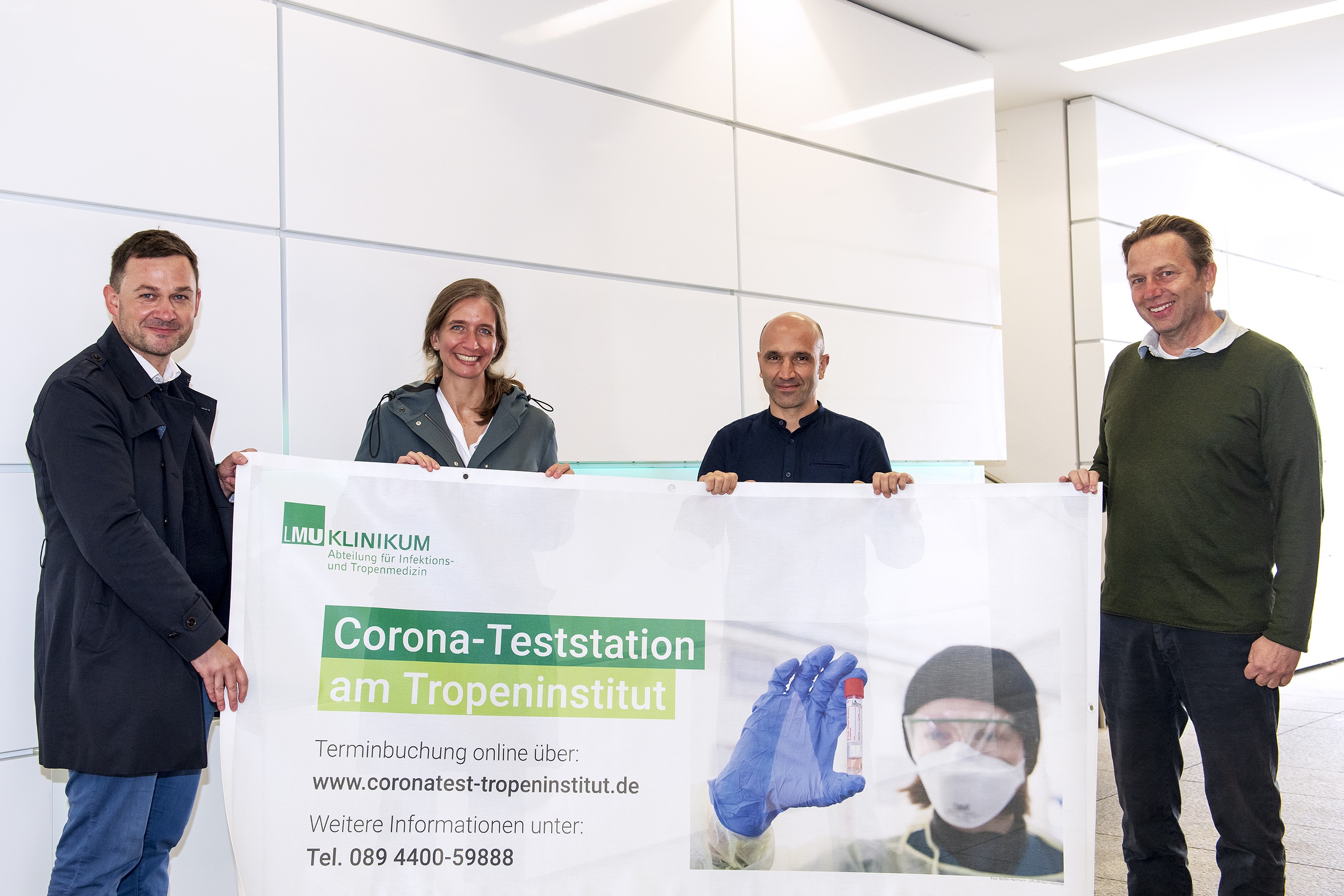
v.l.n.r. Dr. Nüßlein (HdBG), Dr. med. Rothe, Dr. med. Fröschl und Prof. Dr. med. Hoelscher bei der Übergabe der Exponate (im Bild: Infobanner) des Münchner Tropeninstituts. ©LMU Klinikum München/Steffen Hartmann

The team led by Dr. Camilla Rothe from the Munich Tropical Institute diagnosed the first ever case of COVID-19 in Germany on January 27, 2020 (supported by the Bundeswehr Institute of Microbiology). Under the leadership of Dr. med. Günter Fröschl and his team, the Tropical Institute set up a COVID-19 test unit in a separate building area of the institute the next day, probably the first test station in Germany. By decision of the Bavarian State Government and together with the City of Munich, the test capacities were then expanded by a tent in the outdoor area of the Tropical Institute (Georgenstraße) and opened on 23.03.2020 by the Bavarian Minister of Science Bernd Sibler. By the end of the one-year operation of the test station until March 2021, over 10,000 PCR tests had been carried out there (see www.coronatest-tropeninstitut.de).

The objects made available to the Haus der Bayerischen Geschichte (HdBG) provide an exemplary insight into the changes in everyday working life and the special challenges faced by the team at the Tropical Institute in times of the COVID-19 pandemic in Bavaria.

Corona is fit for a museum!

As part of its museum collecting activities, the Haus der Bayerischen Geschichte at Donaumarkt in Regensburg is looking for objects that tell stories and serve to document current social, cultural or political events and developments in Bavaria.

This applies in particular to evidence from the time of the coronavirus pandemic, which has affected all people living in Bavaria and has impacted their everyday lives in many different ways and continues to do so.

In view of this, the HdBG's collecting activities aim to document the course of the corona pandemic in Bavaria with objects and also to shed light on its effects on central areas of social life (e.g. homeschooling or canceled major events).

Among the "Corona objects" already in the depot are a Corona motif from the Altötting Chapel of Mercy, the sample jug from the Gäubodenfest 2020, which was canceled due to Corona, or the "(Kl)Osterpakete" from Münsterschwarzach Abbey (Easter celebrations 2020/2021 at home).

The objects are inventoried with their respective background history and stored in the depot. As part of the redesign of parts of the permanent exhibition planned for 2025, corona objects will probably also be presented in the museum of the HdBG.

Further information about the House of Bavarian History can be found at www.hdbg.de

Source: Press release House of Bavarian History, 07.10.2021