Center for Neurostimulation - CNSᴸᴹᵁ
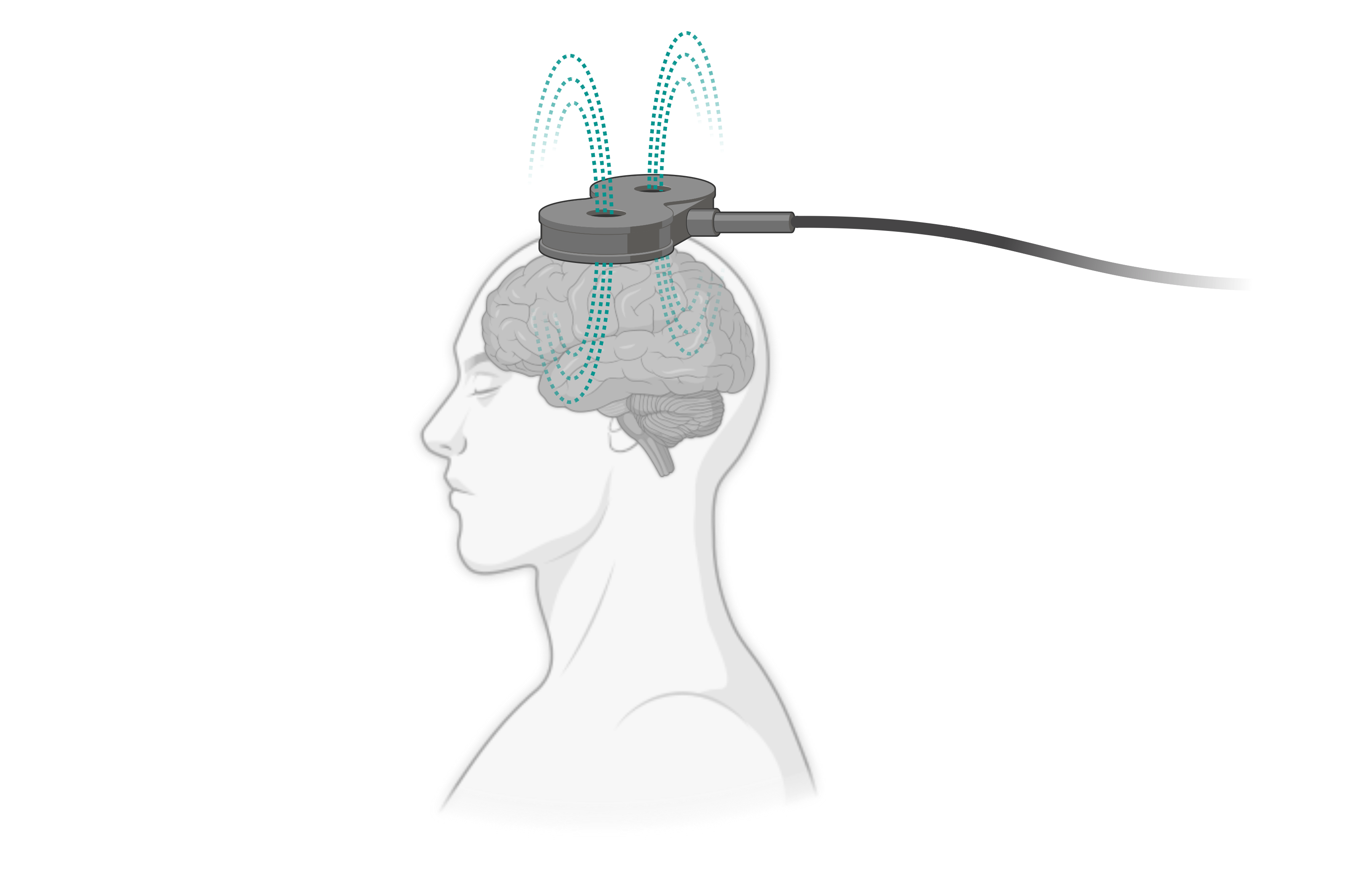
“What fires together, wires together.” This principle underscores the remarkable plasticity of our brain, which contains over 86 billion neurons interconnected in intricate networks. These connections—ranging from strong to weak and fast to slow—enable us to learn, form memories, and adapt to our environment. However, this same plasticity can make mental health disorders difficult to treat.
Non-invasive brain stimulation (NIBS) offers a way to modulate neural connections. Techniques like transcranial direct current stimulation (tDCS) and transcranial magnetic stimulation (TMS) have become invaluable tools for exploring brain function and understanding mental health disorders. Moreover, they are increasingly applied in innovative treatments for conditions such as major depression.
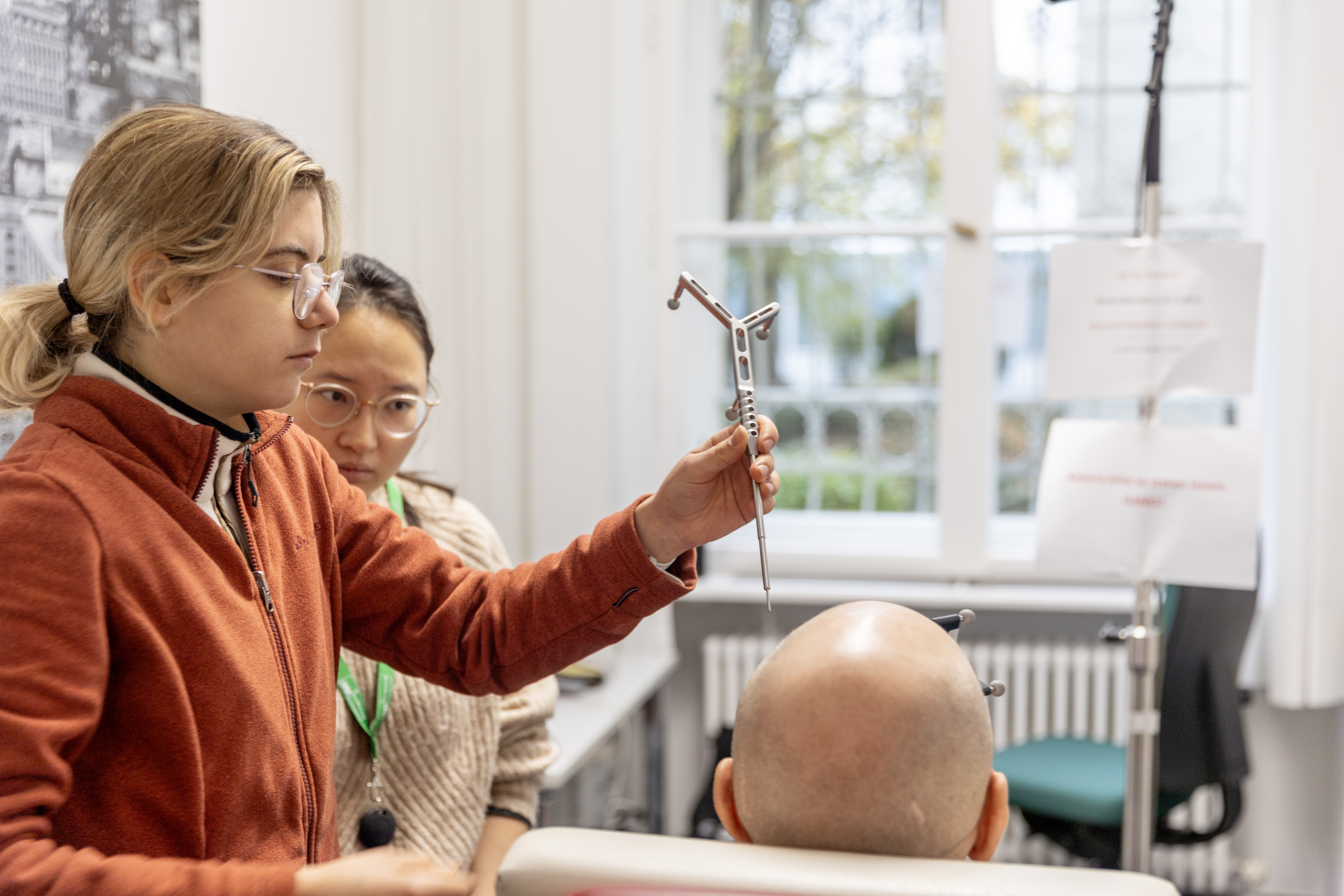
Our ultimate goal is to bridge the gap between basic research and clinical practice, translating scientific insights into effective, evidence-based care for patients with mental health disorders.
Co-lead
Core research team
- Dr. Jonas Björklund
- Esther Dechantsreiter, M.Sc.
- Beate Dornheim
- Miaoxi Chen, M.Sc.
- Andreas Huth, M.Sc.
- Margarethe Woeckel
Doctoral candidates
- Marlen Becher
- Juna Bizhga
- Kristin Hagenah
- Barbara Huber
- Pia Reichelmeir
- Hilde Steinbeck
- Lisa Tagnin
- Helena Wagner
- Katharina von Wartensleben
Research Group Multimodal Neuroimaging and Neuromodulation
- Lead: Dr. Daniel Keeser
- Yang Ye
Early intervention with repetitive theta burst stimulation in adolescents and young adults with depressive disorders: a sequential Bayesian, randomized controlled pilot trial (EARLY-BURST)
- This study investigates whether a 6-week treatment with intermittent theta burst stimulation in adolescents and young adults with depressive disorders, who have not been treated with medication in the last 12 months (except for short-term on-demand medication), effectively reduces depressive symptoms.
- Funded by the German Federal Ministry of Education and Research (BMBF) as part of the German Center for Mental Health (DZPG) and the Medical & Clinician Scientist Program (MCSP) of the LMU Faculty of Medicine
- Registration: DRKS00033313 (German Clinical Trials Register)
Efficacy of repetitive transcranial magnetic stimulation (rTMS) for the acute treatment of depressive symptoms in adolescents and young adults: a protocol for a systematic review and individual patient data meta-analysis
This systematic review and individual patient data meta-analysis aims to answer the following questions: What is the effect of acute treatment with repetitive transcranial magnetic stimulation (rTMS) compared with sham controls in adolescents and young adults with depressive symptoms? Which patient characteristics moderate its effect on depression outcomes (depressive symptom severity, treatment response, remission)?
- Funded by the German Federal Ministry of Education and Research (BMBF) as part of the German Center for Mental Health (DZPG)
- Registration: CRD42024592765 (PROSPERO 2024)
Effectiveness of rTMS compared to SSRI as early treatment of depression (Early-TMS)
- Randomized, rater-blinded, multicenter phase 2 trial comparing bilateral theta burst stimulation (TBS) with SSRI treatment as first-line therapy for major depression.
- Sponsor: University of Tübingen
- Funded by the Deutsche Forschungsgemeinschaft (DFG) & by the German Federal Ministry of Education and Research (BMBF) as part of the German Center for Mental Health (DZPG)
- Registration: NCT06545474 (ClinicalTrials.gov)
BEAM: Brain Stimulation for Ethiopia’s Advanced Mental health care
- Bilateral project to establish Ethiopia’s first national rTMS unit for treatment-resistant depression at SPHMMC in Addis Ababa, including infrastructure development and specialist training at the Center for Neurostimulation.
- Cooperation Partners: St. Paul’s Hospital Millennium Medical College (Surafel Worku), Department of Psychiatry and Psychotherapy at LMU University Hospital (PD Dr. Andrea Jobst-Heel), Center for Neurostimulation (CNSLMU) at LMU University Hospital (Prof. Frank Padberg, Dr. Gerrit Burkhardt)
- Funded by the Federal Ministry for Economic Cooperation and Development and the Else Kröner-Fresenius-Stiftung over GIZ (Deutsche Gesellschaft für Internationale Zusammenarbeit) – Funding line Klinikpartnerschaften Global (2025-2027)
Neurobiological Signatures of Transcranial Magnetic Stimulation in Depression: Characterization of Treatment Trajectories through Interleaved TMS-fMRI (THREAD - TMS-fMRI Module)
- The aim of this project is to characterize the immediate neural effects of intermittent theta burst stimulation (iTBS) in patients with depression using interleaved TMS-fMRI, measuring dose-dependent BOLD responses and connectivity modulations in prefrontal cortex regions and depression-relevant networks during a clinical iTBS treatment course
- Funded through the Funding programme for research and teaching (FöFoLe) Start-up financing of the LMU Faculty of Medicine
The DiSCoVeR Project: Examining the synergistic effects of a cognitive control videogame and self-administered non-invasive brain stimulation on alleviating depression (DiSCoVeR)
- Multicenter, double-blind, two-arm, placebo-controlled randomized trial (RCT) testing the feasibility and efficacy of an innovative, remotely-controlled treatment approach for major depression
- Sponsor: The Hebrew University of Jerusalem
- Funded by ERA-NET NEURON (Network of European Funding for Neuroscience Research, European Commission), German Federal Ministry of Education and Research (BMBF), Ministry of Health (MOH) of Israel, Swiss National Science Foundation (SNSF) and State Education and Development Agency (VIAA) of Latvia
- Registration: NCT04953208 (ClinicalTrials.gov)
MR-informed, navigated transcranial magnetic stimulation with interleaved functional MR-imaging (MR-stim)
- The aim of this project is to establish a paradigm measuring the online modulation (functional MR) of prefrontal cortex regions involved in pathogenesis of depression to be used as predictor of treatment response to non-invasive brain stimulation
- Funded as part of the ERA-NET NEURON-funded The DiSCoVeR Project and Medical & Clinician Scientist Program (MCSP) of the LMU Faculty of Medicine
Brain stimulation for depression-associated symptoms – a real-world clinical investigation of noninvasive brain stimulation treatments offered at the Department of Psychiatry and Psychotherapy of the LMU Hospital
- This project aims at implementing a structured, scientific assessment of non-invasive brain stimulation treatments currently offered at our outpatient and inpatient service. We have been able to offer TMS and tDCS treatments to over 1000 patients starting in 1998. Such a large, naturalistic cohort offers a unique possibility to gain insights about the real-world application of non-invasive brain stimulation interventions. Furthermore, these data have the potential to guide our future clinical decision making processes and to improve the treatment of the specific cohort of patients who present at our center.
- Registration: DRKS00024776 (German Clinical Trials Register)
Treatment of major depressive disorder with bilateral theta burst stimulation (TBS-D)
- Randomized, double-blind, sham-controlled multicenter clinical trial testing the efficacy of TBS as a treatment approach for major depression.
- Sponsor: University of Tübingen
- Funded by the German Federal Ministry of Education and Research (BMBF)
- Registration: NCT04392947 (ClinicalTrials.gov)
Validation of a Single-Subject Treatment Outcome Predictor for Repetitive Transcranial Magnetic Stimulation (rTMS) to Improve Negative Symptoms in Schizophrenia (PREMISS)
- Multicenter study aimed at 1.) validating a single-subject treatment outcome predictor for high-frequency repetitive transcranial magnetic stimulation (rTMS) applied to improve negative symptoms in schizophrenia spectrum disorders, 2.) evaluating the efficacy of rTMS in reducing negative symptoms in schizophrenia spectrum disorders in a naturalistic setting and 3.) evaluating whether an extension with intermittent theta burst stimulation (iTBS) is superior to an extension of rTMS in initial non-responders
- Funded by ERA PerMed (01KU1905B)
- Registration: DRKS00022214 (German Clinical Trials Register)
- Multicentre, double-blind, randomised, sham-controlled clinical trial. To assess the efficacy of bilateral continuous theta burst stimulation (cTBS) as a therapeutic intervention against auditory hallucinations in schizophrenia.
- Sponsor: University of Tübingen
- Funded by Deutsche Forschungsgemeinschaft (DFG)
- Registration: NCT02670291 (ClinicalTrials.gov)
Pathophysiology-specific development of transcranial direct current stimulation (tDCS) of the prefrontal cortex – studies on functional MRT connectivity
- Sponsor: LMU University Hospital
- Funded by the German Federal Ministry of Education and Research (BMBF) as part of the German Center for Brain Stimulation Research network
Transcranial direct current stimulation (tDCS) as a treatment for major depression (Depression DC)
- A prospective multicentre double-blind randomized placebo-controlled trial investigating the efficacy and tolerability of repeated tDCS as treatment for major depression.
- Sponsor: LMU University Hospital
- Funded by the German Federal Ministry of Education and Research (BMBF) as part of the German Center for Brain Stimulation Research network
- Registration: NCT02530164 (ClinicalTrials.gov)
- Randomized, double-blind, placebo-controlled multicenter trial to investigate if cognitive-behavioral psychotherapy (CBT) when combined with prefrontal transcranial direct current stimulation (tDCS) is more efficacious than CBT with sham tDCS or CBT alone.
- Sponsor: Charite Berlin
- Funded by the German Federal Ministry of Education and Research (BMBF) as part of the German Center for Brain Stimulation Research network
- Registration: NCT02633449 (ClinicalTrials.gov)
- Theta burst stimulation of temporo-parietal cortex regions for the treatment of persistent auditory hallucinations: a multicentre, randomised, sham-controlled, triple-blind phase 3 trial in Germany Plewnia C, Brendel B, Schwippel T, Becker-Sadzio J, Hajiyev I, Pross B, Strube W, Hasan A, Campana M, Padberg F, Mayer P, Kujovic M, Lorenz S, Schönfeldt-Lecuona C, Otte M-L, Wolf RC, Höppner-Buchmann J, Serna-Higuita LM, Martus P, Fallgatter AJ. Lancet Psychiatry 2025
- Dose-Dependent Target Engagement of a Clinical Intermittent Theta Burst Stimulation Protocol: An Interleaved Transcranial Magnetic Stimulation–Functional Magnetic Resonance Imaging Study in Healthy People Chang KY, Tik M, Mizutani-Tiebel Y, Taylor P, van Hattem T, Falkai P, Padberg F, Bulubas L, Keeser D. Biological Psychiatry: Cognitive Neuroscience and Neuroimaging
2024
- Transcranial direct current stimulation as an additional treatment to selective serotonin reuptake inhibitors in adults with major depressive disorder in Germany (DepressionDC): a triple-blind, randomised, sham-controlled, multicentre trial Burkhardt G, Kumpf U, Crispin A, Goerigk S, Andre E, Plewnia C, Brendel B, Fallgatter A, Langguth B, Abdelnaim M, Hebel T, Normann C, Frase L, Zwanzger P, Diemer J, Kammer T, Schönfeldt-Lecuona C, Kamp D, Bajbouj M, Behler N, Wilkening A, Nenov-Matt T, Dechantsreiter E, Keeser D, Bulubas L, Palm U, Blankenstein C, Mansmann U, Falkai P, Brunoni A, Hasan A, Padberg F. Lancet 2023
- Effects of repetitive transcranial magnetic stimulation of the left dorsolateral prefrontal cortex on symptom domains in neuropsychiatric disorders: a systematic review and cross-diagnostic meta-analysis Kan RL, Padberg F, Giron CG, Lin TTZ, Zhang BB, Brunoni AR, Kranz GS. Lancet Psychiatry 2023
- Efficacy of Augmentation of Cognitive Behavioral Therapy With Transcranial Direct Current Stimulation for Depression: A Randomized Clinical Trial Aust S, Brakemeier E-L, Spies J, Herrera-Melendez A L, Kaiser T, Fallgatter A, Plewnia C, Mayer S V, Dechantsreiter E, Burkhardt G, Strauß M, Mauche N, Normann C, Frase L, Deuschle M, Böhringer A, Padberg F, Bajbouj M. JAMA Psychiatry 2022
- Efficacy and Safety of Transcranial Direct Current Stimulation for Treating Negative Symptoms in Schizophrenia: A Randomized Clinical Trial Valiengo LDCL, Goerigk S, Gordon PC, Padberg F, Serpa MH, Koebe S, Santos LAD, Lovera RAM, Carvalho JB, van de Bilt M, Lacerda ALT, Elkis H, Gattaz WF, Brunoni AR. JAMA Psychiatry 2020
- Clinical patterns differentially predict response to transcranial direct current stimulation (tDCS) and escitalopram in major depression: A machine learning analysis of the ELECT-TDCS study Kambeitz J, Goerigk S, Gattaz W, Falkai P, Benseñor IM, Lotufo PA, Bühner M, Koutsouleris N, Padberg F, Brunoni AR. J Affect Disord. 2020
- Antidepressant effects of tDCS are associated with prefrontal gray matter volumes at baseline: Evidence from the ELECT-TDCS trial Bulubas L, Padberg F, Bueno PV, Duran F, Busatto G, Amaro E Jr, Benseñor IM, Lotufo PA, Goerigk S, Gattaz W, Keeser D, Brunoni AR. Brain Stimulation 2019
- Testing assumptions on prefrontal transcranial direct current stimulation: Comparison of electrode montages using multimodal fMRI Wörsching J, Padberg F, Goerigk S, Heinz I, Bauer C, Plewnia C, Hasan A, Ertl-Wagner B, Keeser D. Brain Stimulation 2018
- Test-retest reliability of prefrontal transcranial Direct Current Stimulation (tDCS) effects on functional MRI connectivity in healthy subjects Wörsching J, Padberg F, Helbich K, Hasan A, Koch L, Goerigk S, Stoecklein S, Ertl-Wagner B, Keeser D. Neuroimage 2017
- Prefrontal Transcranial Direct Current Stimulation for Treatment of Schizophrenia With Predominant Negative Symptoms: A Double-Blind, Sham-Controlled Proof-of-Concept Study Palm U, Keeser D, Hasan A, Kupka MJ, Blautzik J, Sarubin N, Kaymakanova F, Unger I, Falkai P, Meindl T, Ertl-Wagner B, Padberg F. Schizophr Bull. 2016
- Imaging transcranial direct current stimulation (tDCS) of the prefrontal cortex-correlation or causality in stimulation-mediated effects? Wörsching J, Padberg F, Ertl-Wagner B, Kumpf U, Kirsch B, Keeser D. Neurosci Biobehav Rev. 2016
- Efficacy and safety of deep transcranial magnetic stimulation for major depression: a prospective multicenter randomized controlled trial Levkovitz Y, Isserles M, Padberg F, Lisanby SH, Bystritsky A, Xia G, Tendler A, Daskalakis ZJ, Winston JL, Dannon P, Hafez HM, Reti IM, Morales OG, Schlaepfer TE, Hollander E, Berman JA, Husain MM, Sofer U, Stein A, Adler S, Deutsch L, Deutsch F, Roth Y, George MS, Zangen A. World Psychiatry 2015
- Prefrontal transcranial direct current stimulation changes connectivity of resting-state networks during fMRI Keeser D, Meindl T, Bor J, Palm U, Pogarell O, Mulert C, Brunelin J, Möller HJ, Reiser M, Padberg F. J Neurosci. 2011
- Theta burst stimulation of the prefrontal cortex: safety and impact on cognition, mood, and resting electroencephalogram Grossheinrich N, Rau A, Pogarell O, Hennig-Fast K, Reinl M, Karch S, Dieler A, Leicht G, Mulert C, Sterr A, Padberg F. Biol Psychiatry 2009
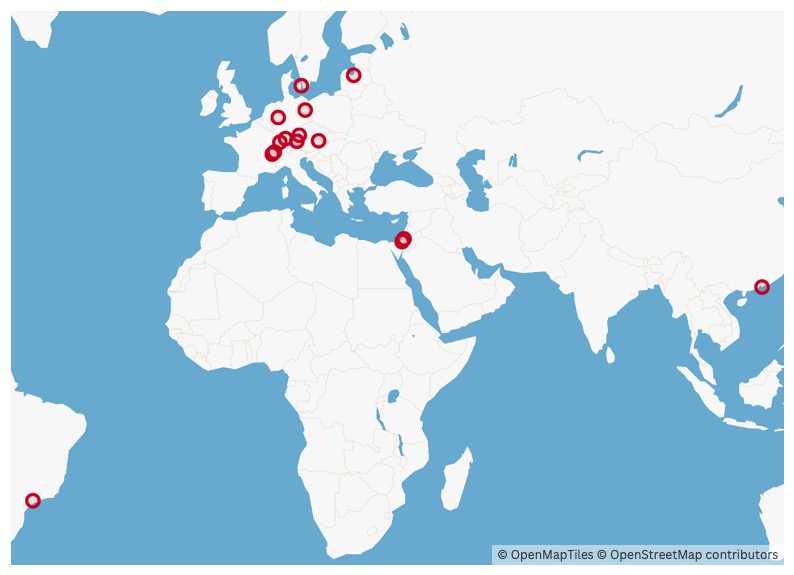
- Malek Bajbouj, Charite Berlin
- Daphné Bavelier, University of Geneva
- Andre Russowsky Brunoni, Universidade de São Paulo
- Stephan Goerigk, Fresenius Hochschule Munich
- Friedhelm Hummel, Swiss Federal Institute of Technology EPFL, Geneva
- Georg Kranz, The Hongkong Polytechnic University
- Berthold Langguth, University of Regensburg
- Mor Nahum, The Hebrew University of Jerusalem
- Michael Nitsche, TU Dortmund
- Claus Normann, University of Freiburg
- Christian Plewnia, University of Tuebingen
- Elmars Rancans, Riga Stradins University
- Lais Razza, Ghent University
- Hartwig R. Siebner, Danish Research Center for Magnetic Resonance, Copenhagen
- Martin Tik, University of Vienna
- Axel Thielscher, Danish Research Center for Magnetic Resonance, Copenhagen
- Ulrike Vogelmann, TU Munich
- Christian Windischberger, University of Vienna
- Abraham Zangen, Ben-Gurion University of the Negev
For our studies, we are constantly recruiting patients with major depressive disorder (German language required). You can find information on studies for which we currently search participants here. Feel free to contact our study coordination office.
Für unsere Studien suchen wir kontinuierlich Patient*innen mit Depression. Hier können Sie weitere Informationen zu aktuellen Projekten finden. Kontaktieren Sie bei Interesse gerne unser Studienteam.
We invite advanced medical and psychology students to apply for a research internship with our group. As an intern, you will gain valuable experience at a renowned multidisciplinary university hospital, participate in our scientific curriculum (including seminars and congresses), and engage in clinical care.
You’ll have the chance to conduct a research project based on established studies or your ideas (if feasible), tailored to your interests. We encourage and support students in writing for international journals, including publishing their research or master’s/doctoral thesis.
We welcome both national and international students. However, basic German language skills are required due to patient interactions. Interested? Please send us your CV and reach out via email!