Retinal Psychiatry
Head
- Dr. Dr. med. Florian Raabe – Mail: florian.raabe@med.uni-muenchen.de
Group members
- Emanuel Boudriot
- Alexandra Hirsch
Alumni
- Vanessa Gabriel
Overview
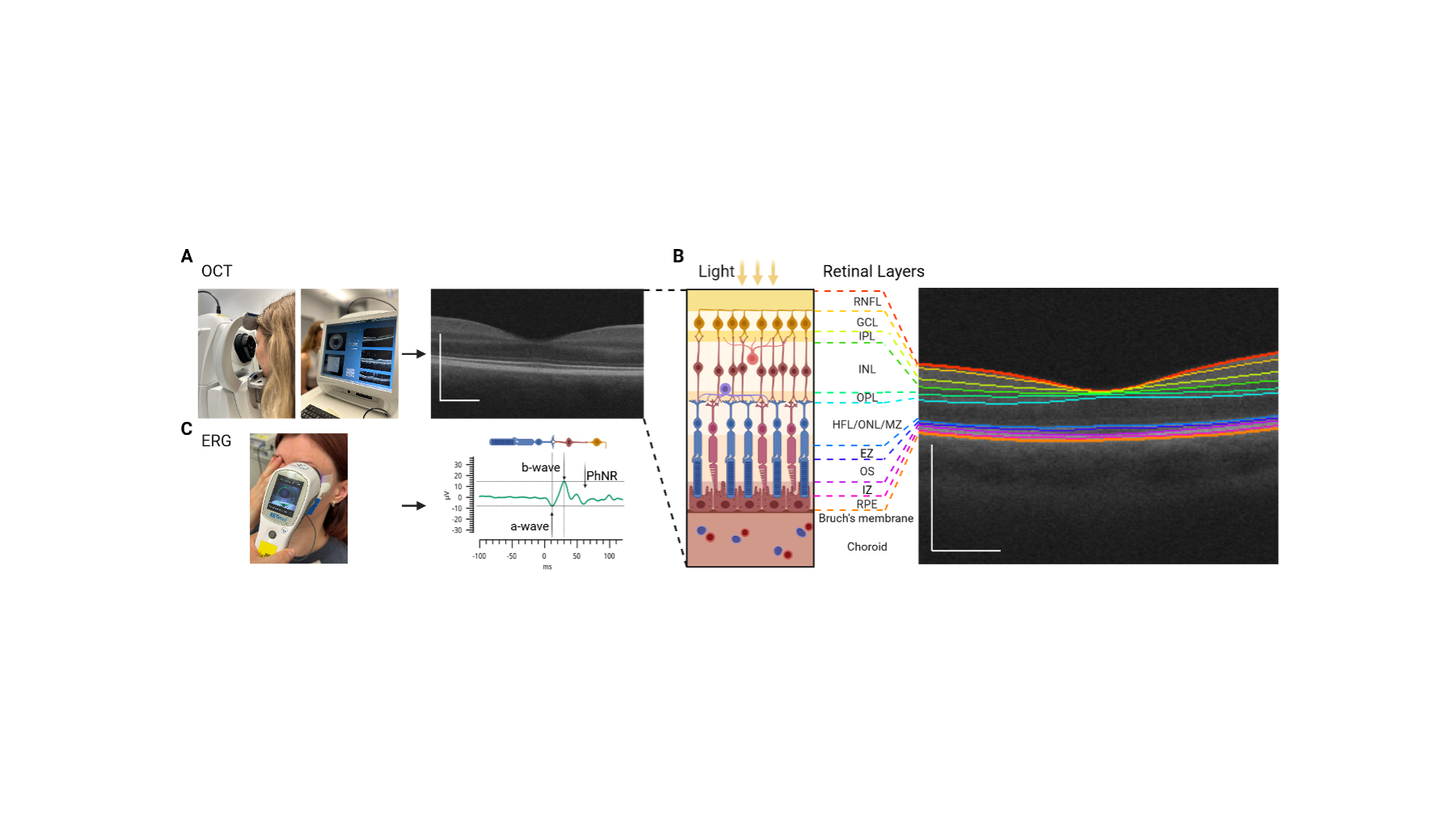
The Retinal Psychiatry group investigates the retina as an accessible part of the central nervous system to gain novel insights into the pathophysiology of schizophrenia spectrum disorders (SSDs) and other neuropsychiatric conditions. Originating from the developing brain, the retina shares anatomical, developmental, and functional characteristics with cortical structures, including similar neurotransmitter systems and layered neuronal-glial organization.
By applying advanced imaging techniques such as optical coherence tomography (OCT) and electroretinography (ERG), combined with multimodal deep phenotyping and genetic analyses, we aim to:
- Identify disease-relevant retinal biomarkers for schizophrenia spectrum disorders (SSDs).
- Link retinal microstructural and electrophysiological alterations to genetic risk and clinical phenotypes.
- Advance translational approaches to understand (inter)neuronal and synaptic dysfunction in schizophrenia in vivo.
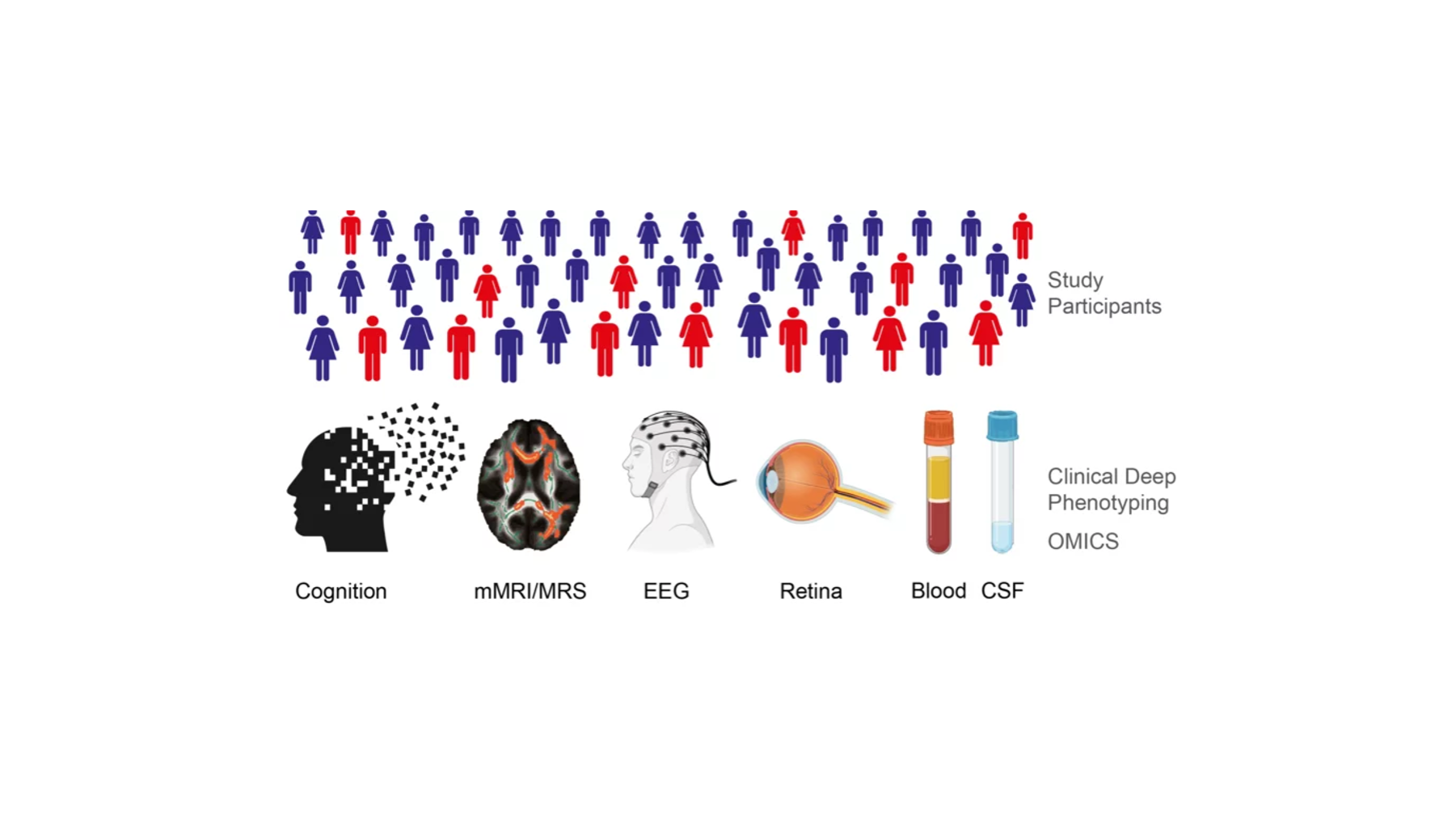
The working group Retinal Psychiatry is operating within the framework of the CDP Working Group, a local research consortium based at LMU Munich, MPI Psychiatry, and the University of Augsburg. The Clinical Deep Phenotyping (CDP) Study is a comprehensive, multicenter initiative designed to unravel the complex biological, clinical, and cognitive underpinnings of severe mental illnesses, with a focus on psychotic disorders. By integrating extensive phenotypic assessments—including neuroimaging, retinal assessments, cognitive testing, digital phenotyping, biosampling, and detailed clinical evaluations—the study aims to identify transdiagnostic biomarkers and stratify patient subgroups based on biologically grounded dimensions. Through this deep phenotyping approach, the CDP Working Group aims to support the development of precision psychiatry tools that can inform individualized diagnosis, prognosis, and treatment, ultimately improving outcomes for people living with severe psychiatric conditions.
- CDP Study: DRKS00024177
- CDP-STAR Study: DRKS00034820
Key publications:
- Boudriot, E., Stephan, M., Rabe, F., Smigielski, L., Schmitt, A., Falkai, P., Ziller, M. J., Rossner, M. J., Homan, P., Papiol, S., & Raabe, F. J. (2025). Genetic Analysis of Retinal Cell Types in Neuropsychiatric Disorders. JAMA Psychiatry. https://doi.org/10.1001/jamapsychiatry.2024.4230
- Boudriot, E., Gabriel, V., Popovic, D., Pingen, P., Yakimov, V., Papiol, S., Roell, L., Hasanaj, G., Xu, S., Moussiopoulou, J., Priglinger, S., Kern, C., Schulte, E. C., Hasan, A., Pogarell, O., Falkai, P., Schmitt, A., Schworm, B., Group, C. D. P. W., . . . Raabe, F. J. (2024). Signature of altered retinal microstructures and electrophysiology in schizophrenia spectrum disorders is associated with disease severity and polygenic risk. Biol Psychiatry. https://doi.org/10.1016/j.biopsych.2024.04.014
- Krčmář, L., Jäger, I., Boudriot, E., …., Pogarell, O., Falkai, P., Schmitt, A., Wagner, E., Keeser, D., & Raabe, F. J. (2023). The multimodal Munich Clinical Deep Phenotyping study to bridge the translational gap in severe mental illness treatment research. Frontiers in Psychiatry, 14. https://doi.org/10.3389/fpsyt.2023.1179811
- Boudriot, E., Schworm, B., Slapakova, L., Hanken, K., Jager, I., Stephan, M., . . . Raabe, F. J. (2022). Optical coherence tomography reveals retinal thinning in schizophrenia spectrum disorders. Eur Arch Psychiatry Clin Neurosci. https://doi.org/10.1007/s00406-022-01455-z
- Peter Falkai, Department of Psychiatry and Psychotherapy, LMU University Hospital, LMU Munich, Munich, Germany
- Philipp Homann, Department of Psychiatry and Psychotherapy, University of Zurich
- Daniel Keeser, NeuroImaging Core Unit Munich (NICUM), University Hospital, LMU Munich
- Andrea Schmitt, Department of Psychiatry and Psychotherapy, LMU University Hospital, LMU Munich, Munich, Germany
- Eva Schulte, Department of Psychiatry and Psychotherapy, University Hospital, Faculty of Medicine, University of Bonn
- Benedikt Schworm, Department of Ophthalmology, LMU University Hospital, LMU Munich, Munich, Germany
- Elias Wagner, Department of Psychiatry, Psychotherapy, and Psychosomatics, Medical Faculty, University of Augsburg