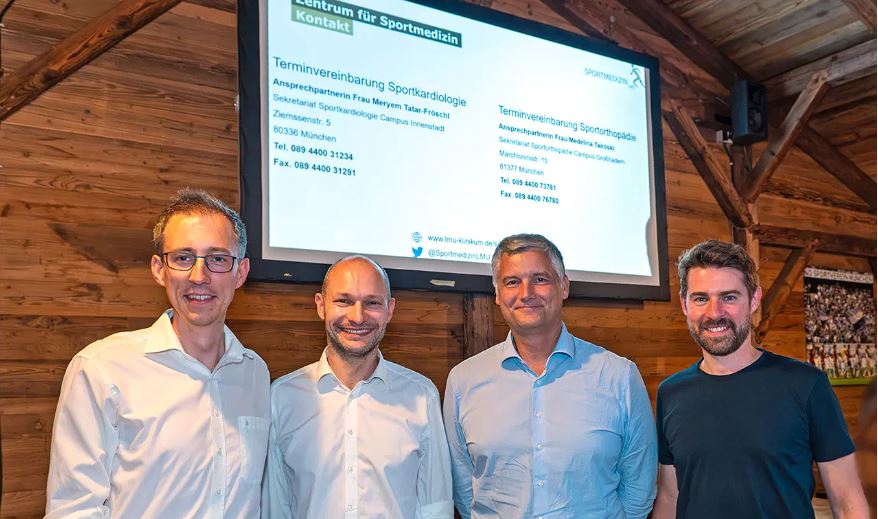
New: Center for Sports Medicine at the LMU Hospital
The speakers were cardiologists Prof. Stefan Brunner, PD Dr. Korbinian Lackermair, Dr. Pontus Mertsch (Medical Clinic I) and orthopaedists Prof. Peter Müller and PD Dr. Thomas Niethammer (Musculoskeletal University Center Munich, MUM). Sports medicine covers a broad spectrum of medical expertise. In order to cover this, the Center for Sports Medicine at the LMU Clinic cooperates with the Medical Clinics II (Gastroenterology and Hepatology), III (Oncology), IV (Metabolism, Nephrology and Endocrinology) and V (Pneumology) as well as Radiology, the Ear, Nose and Throat Clinic, Visceral Surgery and Psychiatry. The breadth and at the same time high quality of the specialties at the LMU Clinic is an ideal basis for the Center for Sports Medicine.
Cardiovascular system and sport
Initially, issues relating to heart failure and the benefits of exercise were discussed - today, compared to the 1980s, it is generally the case that a combination of strength and endurance training, adapted to individual requirements, has clear health benefits compared to resting and immobilizing patients. A number of studies over the last twenty years have provided reliable findings in this area. (O'Connor et al. JAMA. 2009 Apr 8; 301(14): 1439-1450, Kitzman et al. N Engl J Med 2021 Jul 15;385(3):203-216).
Prof. Brunner: "Physical activity is also an important pillar of non-drug therapy for heart patients. Careful examination and recommendation of exercise play a decisive role here." (Pelliccia et al. Eur Heart J . 2021 Jan 1;42(1):17-96)
Asthma is also not a contraindication to exercise. With around 6.7 million asthmatics in Germany, there is sufficient experience potential in this patient group. Here too, sport improves symptoms, quality of life and asthma control. However, it must be ensured that patients do not come into increased contact with harmful or allergenic substances. The use of appropriate medication must also be supervised by a doctor and its use carefully coordinated.
Intense physical exertion, especially in competitive situations, can lead to fatal cardiac events in patients with unknown heart disease. The cardiological assessment of fitness for sport is therefore of great importance. A comprehensive medical history and a resting ECG are the cornerstones here, as the mandatory screening program introduced in Italy in 1982 before participation in sport has shown. With the introduction of this screening program, the annual rate of sudden cardiac death during sport was reduced from 3.6 to 0.4 per 100,000 person-years (Corrado et al. JAMA 2006 Oct 4;296(13):1593-601).
Dr. Lackermair: "Sports cardiological fitness testing for non-professional athletes is incomplete in Germany. Deaths during sport therefore almost exclusively affect recreational athletes. (Bohm et al. Can J Cardiol. 2021 Jan;37(1):105-112). A structured program for pre-participation evaluation based on the Italian model therefore seems desirable."
Joints, muscles and tendons
The orthopaedic aspects deal, among other things, with cartilage therapy in the knee area, the joint subject to the most stress in many sports. Studies have shown that after cartilage damage and an individually determined therapy, a twelve-month break from sport for regeneration brings the greatest success.
Dr. Niethammer: "In competitive athletes, osteochondral transplantation leads to the quickest return to sporting activity. However, the choice of cartilage therapy must be individualized and depends on the size and depth of the cartilage defect." (Hurley ET, Davey MS, Jamal MS, Manjunath AK, Alaia MJ, Strauss EJ. Return-to-Play and Rehabilitation Protocols following Cartilage Restoration Procedures of the Knee: A Systematic Review. Cartilage. 2021 Dec 13(1_suppl):907S-914S).
The situation is somewhat different for shoulder injuries. Traumatic, overuse-related and, in older athletes, degenerative injuries occur here. Sports in which the shoulder is a critical factor include gymnastics, handball, volleyball, baseball, tennis and swimming, especially the crawl style (R. Doyscher et al (2014) Akutverletzungen und Überlastungsschäden der Schulter im Sport. Orthopaedics 43: 202-208). Damage is caused by biomechanical extreme loading, but also repetitive continuous loading. If the rotator cuff is damaged, both conservative and surgical measures may be necessary, depending on the cause, the age of the athlete and the demands. However, a break of at least 6 months should then be planned.
Prof. Müller: "Traumatic damage in young athletes in particular usually requires surgery, with very good results. In older athletes with degenerative damage, conservative therapy can be attempted for 6 weeks; if there is no improvement, surgery can then be performed, usually with good results. Damage to the rotator cuff caused by overuse is problematic in young competitive athletes who play overhead sports. Here, conservative and surgical treatment often fails to achieve the full level of performance. (Lazarides AL, Alentorn-Geli E, Choi JH, Stuart JJ, Lo IK, Garrigues GE, Taylor DC. Rotator cuff tears in young patients: a different disease than rotator cuff tears in elderly patients. J Shoulder Elbow Surg. 2015 Nov;24(11):1834-43.").
The Center for Sports Medicine at the LMU Clinic already cooperates with several associations and sports clubs. In addition, the Center for Sports Medicine cooperates with all departments of the LMU Klinikum. This makes the newly founded center an important partner for clinical studies and an outstanding point of contact for referring physicians and patients.
Mr. Prof. Dr. med. Brunner, Stefan
Senior Consultant, Head of the Center for Sports Medicine | Medical Clinic and Polyclinic I LMU Klinikum Innenstadt
Prof. Dr. med. Peter Müller
Deputy Clinic Director, Head of the Center for Sports Medicine | Musculoskeletal University Center Munich | LMU Klinikum Großhadern