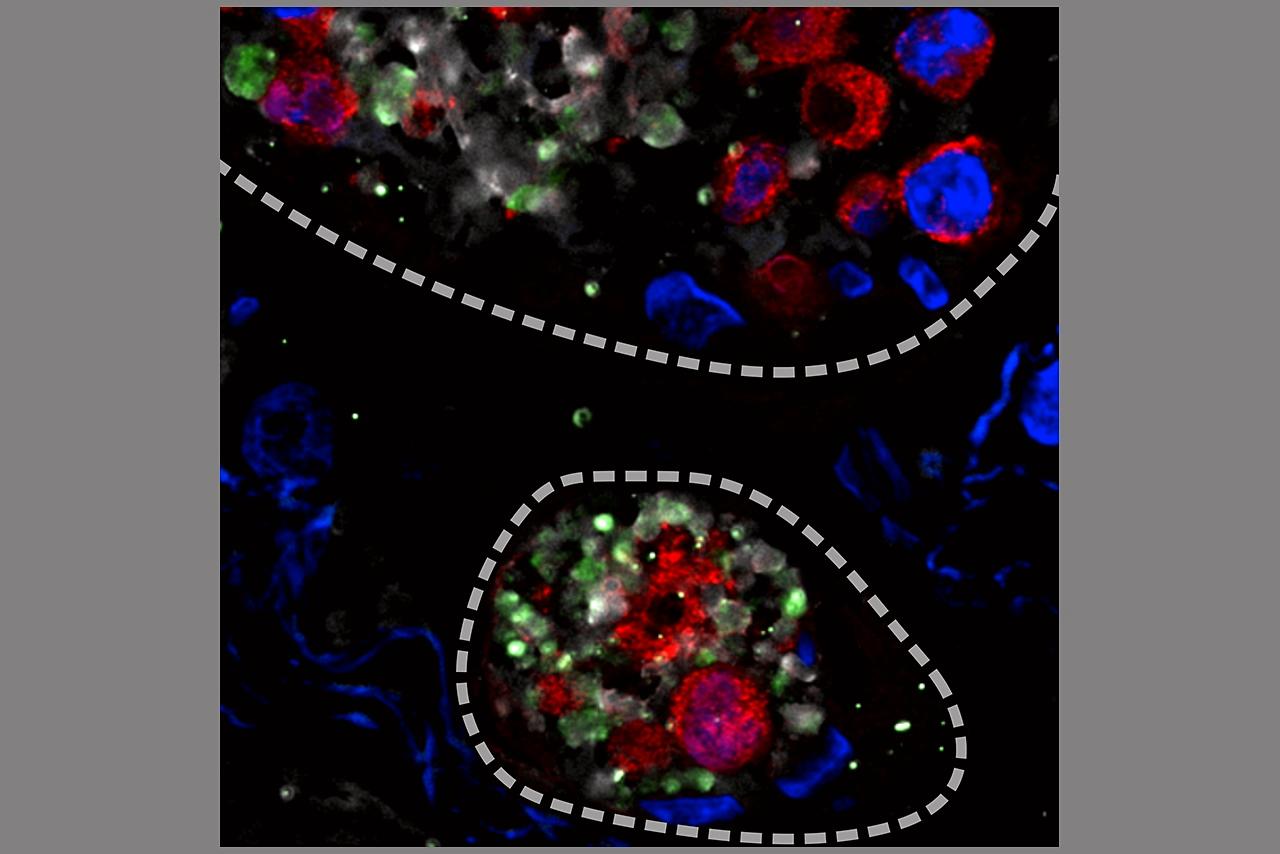
In a paper published in the journal Circulation, the team led by Leo Nicolai, Alexander Leunig, Kami Pekayvaz and Konstantin Stark from the Medical Clinic and Polyclinic I (Cardiology) at the LMU Hospital Munich was able to uncover a pathophysiological interface between changes in the pulmonary vessels and thrombotic complications: The pulmonary vessels of severely ill COVID-19 patients showed numerous thromboses in the smallest blood vessels. The researchers were also able to detect such vascular occlusions in the heart and kidneys. The thrombi consisted mainly of blood platelets and activated inflammatory cells, so-called neutrophil granulocytes. The occlusions detected are caused by inflammatory processes triggering the activation of blood clotting and platelets, which is intended to prevent the spread of viruses and bacteria in the body. However, such vascular occlusions also impair the blood supply to the tissue - which contributes to lung failure - and a systemic tendency to thrombosis develops.
Using multidimensional fluorescence flow analyses, the researchers showed that highly activated neutrophil granulocytes and platelets can be found in the blood of COVID-19 patients with respiratory failure who require ventilation. Both cell types activate each other, which ultimately leads to vascular occlusion in the lungs. So-called NETs (neutrophil extracellular traps) are an essential component of this occlusion formation. These net-like structures made of DNA and granulaproteins of the neutrophil granulocytes stabilize the blood clots. This initially local process in the lungs also leaves its mark in the blood, where blood coagulation is generally strongly activated. This is then reflected in an increased systemic tendency to thrombosis. "These findings contribute to a better understanding of the pathophysiological mechanisms of COVID-19," says Konstantin Stark. "Immunothrombosis is a promising starting point in the prevention and treatment of lung failure and other thrombotic complications of COVID-19."
The study was conducted in collaboration with numerous departments of the LMU Hospital (Anesthesiology, Virology, Clinical Chemistry, Pathology, Medical Clinic III) and was supported by the Collaborative Research Center 1123 and 914 of the German Research Foundation, the European Research Council (ERC), the German Society of Cardiology (DGK) and the Munich Heart Alliance. The publication was awarded as Paper-of-the-month of the German Center for Cardiovascular Diseases.