"Every minute counts in cardiac arrest"
Did you see the game?
Kääb: Yes. And I thought, for God's sake, they're not reacting fast enough. It was immediately clear to me that Mr. Eriksen had a serious arrhythmia because he suddenly fell onto the pitch with his face after walking slowly and without any reaction to support himself.
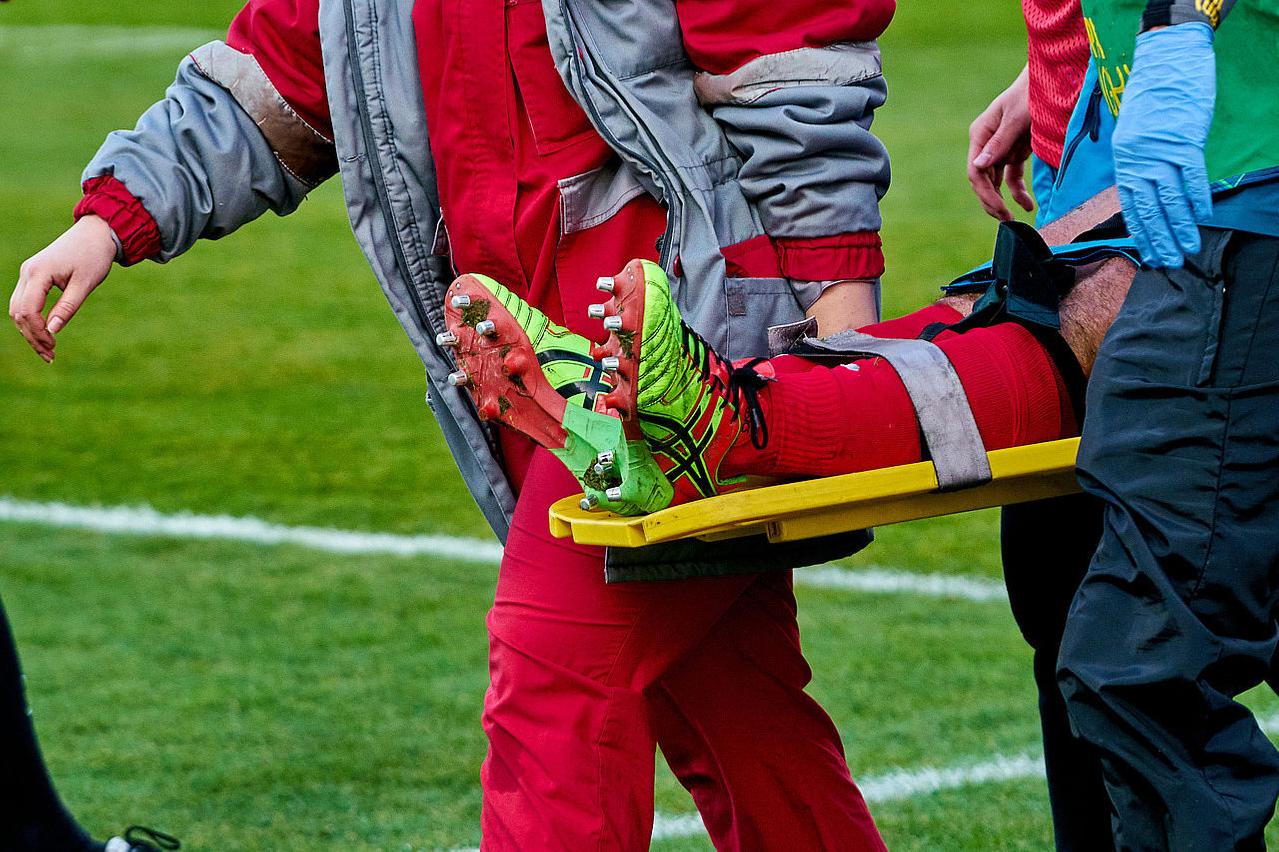
For me, it felt like it took far too long for the paramedics to come trotting across the pitch with the defibrillator. That's why I appeal to you to first check the victim's breathing and vital functions and then immediately start resuscitation, especially chest compressions.
In cardiac arrest, chest compressions are more important than ventilation
How do you check vital functions as a medical layperson?
Kääb: You check whether the person reacts to being spoken to or touched. If not, you feel for a pulse, preferably via the carotid artery. There is a dent that runs diagonally forward along the neck muscle. You can practise this on yourself or your partner if there is no emergency situation.
If there is no pulse, you must assume a cardiovascular arrest and start chest compressions immediately. This is more important than artificial respiration. Every minute counts.
Should a defibrillator be used if one is available?
Kääb: Yes, absolutely. The defibrillator uses an electric shock to stop the dangerous ventricular fibrillation. This is when the heart is only fibrillating and no longer pumping. The electrical impulse restores a regular rhythm.
The devices are labeled "AED" for automatic external defibrillator and automatically start a voice guide the moment you take them off the wall. This guides you through the process, even if you have no previous knowledge. Soccer stadiums are equipped with them and the players and staff actually know what to do in such a case.
Sudden cardiac death is rare in young people
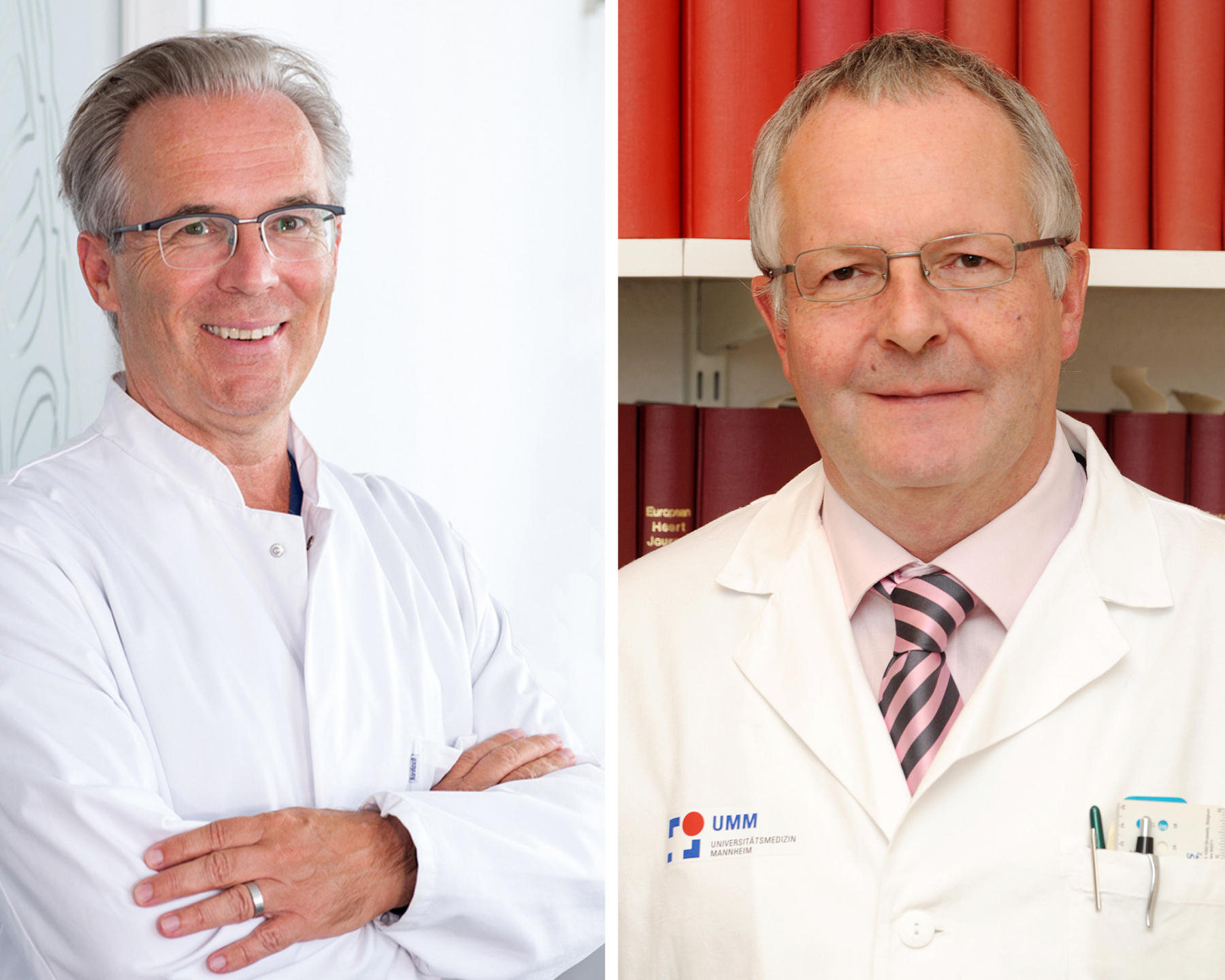
Searching the genes for the cause of sudden cardiac arrest in younger people: Prof. Stefan Kääb (left) and Prof. Martin Borggrefe.
The question that everyone asks is: How can something like this happen virtually out of nowhere, what are the causes of sudden cardiovascular arrest?
Kääb: Even if you get a different impression because sudden cardiac arrest in athletes attracts a lot of attention: in around 80 percent of all cases, a heart attack is the cause and it mainly affects older people. Other causes can be protracted myocarditis, hereditary hypertrophic cardiomyopathy, which is a thickening of the heart wall, and in rare cases arrhythmias such as long QT syndrome, Brugada syndrome or similarly rare familial arrhythmias.
In younger people under 40, the other causes are more common than the heart attack. Only a detailed investigation can reveal what Mr. Eriksen had.
Borggrefe: In Germany, around 9,000 people under the age of 40 suffer a sudden cardiac death every year. An Australian study of young athletes showed that around 50 percent had hereditary forms of arrhythmia, which are essentially the ion channel diseases mentioned by Mr. Kääb. These sometimes manifest themselves in advance with a rapid pulse or atrial fibrillation.
Searching for clues in the genes
In how many cases of sudden cardiac arrest is the cause unknown?
Borggrefe: About five percent. Mr. Kääb and I are conducting a study on this together with colleagues from England and the Netherlands as part of the German Centre for Cardiovascular Research.
We are looking for indications of mutations in the blood and genes of around 1,200 survivors of sudden cardiac arrest under the age of 40 in whom no cause could be found. We then characterize these in the laboratory. If we find something, we also involve the families so that we can provide them with genetic and medical advice.
Incidentally, very few people know this: There is also a mechanical cause of cardiac arrest, known as contusio cordis. If a blunt blow or impact hits the chest, the heart can also stop. Ever since this has been known, ice hockey players have worn chest protectors. Because children were also affected in baseball, a softball is mandatory for them in the USA.
Let's go back to soccer. Are competitive athletes sufficiently checked to prevent such incidents?
Borggrefe: There are big differences here in Europe. In Italy, sports cardiologists are virtually responsible for the health of athletes. They examine them in great detail, from ECGs to genetic tests for risk genes for cardiomyopathies and ion channel diseases.
I know the case of an Italian swimmer who had been doing sport since the age of three. She was found to have a risk gene for long QT syndrome while preparing for the Olympics. As a result, she was excluded from the Olympic squad.
Kääb: That's why some athletes and clubs shy away from such examinations; many don't even have an ECG. Although this is understandable, it is of course a risk to the athletes' health. There needs to be uniform regulation across the EU.
Borggrefe: The case of Gerald Asamoah, a German Bundesliga player with Ghanaian roots, shows that there is another way. In 1998, aged just 20, he was diagnosed with a thickened heart wall following cardiovascular problems. He was advised to retire.
However, he continued to play, the team knew about it and everyone was informed about what to do in an emergency. There was always a defibrillator on the sidelines. He was able to successfully end his career in 2015 without any further incidents.
Competitive sport with a defibrillator - is it possible?
A defibrillator is implanted in people at increased risk to prevent sudden cardiac arrest - Christian Eriksen was also fitted with a defibrillator after the incident. Is competitive sport possible with this?
Borggrefe: A European guideline states that contact sports such as soccer or basketball should not be practiced with a defibrillator. However, I know of a study with American college athletes that shows that it is possible under certain precautions and with close medical supervision.
The interview was conducted by Christine Vollgraf, German Center for Cardiovascular Research (DZHK)
Who to contact
Prof. Dr. med. Stefan Kääb
Medical Clinic I (Cardiology), LMU Hospital